
Subscribe for more!
Subscribe to our newsletter for insights and articles on wide ranging issues including reputation management, branding, advertising, awareness, advocacy, and communications. You can unsubscribe anytime.
Follow us on social:


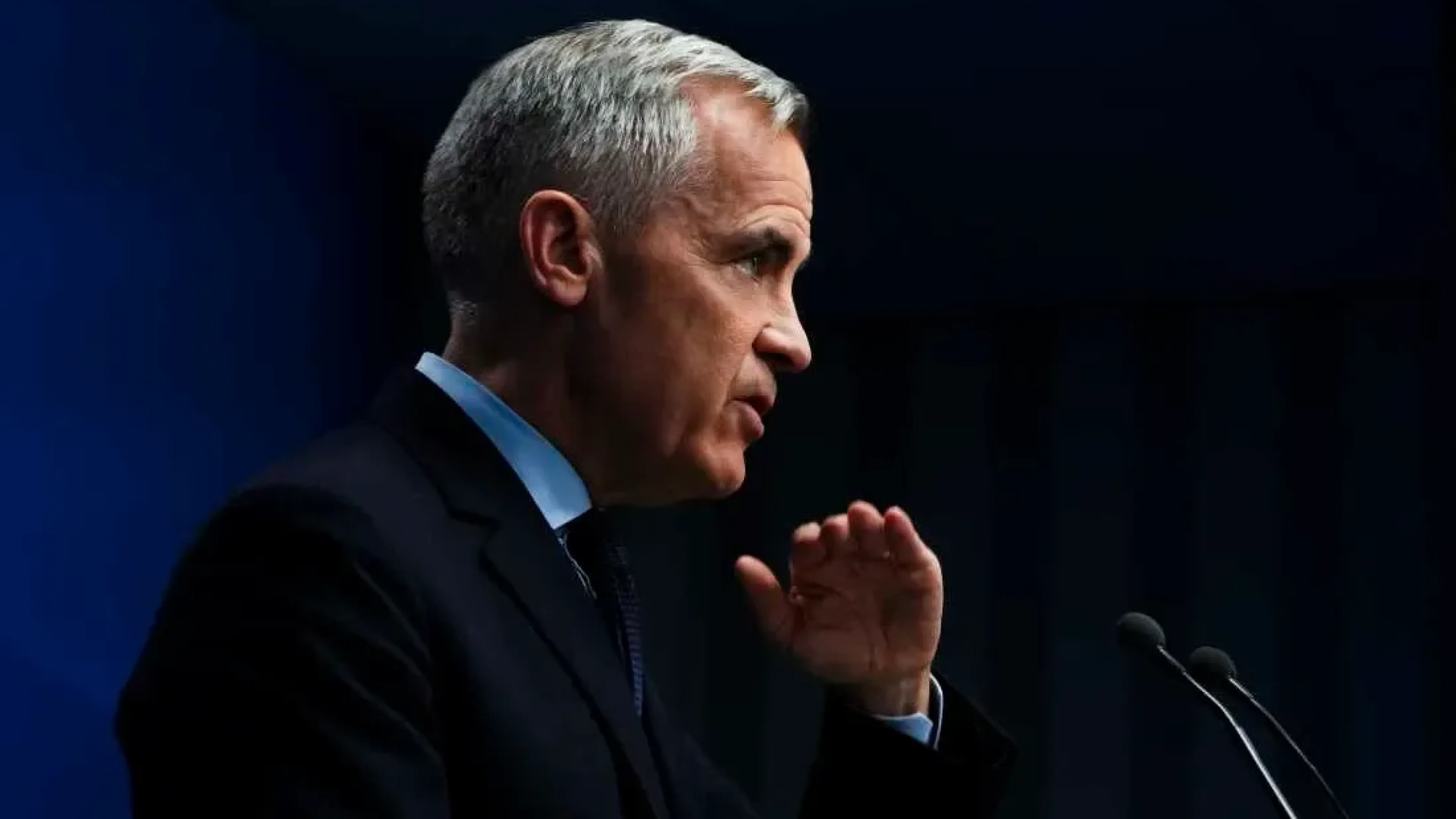
Normally if people are down about the economy they are angry at government. It’s more complicated right now, as people see economic pressures from outside our borders.
Other than tagging every scandal something-gate, It’d be hard to find a more overused phrase in modern political analysis than “it’s the economy, stupid”. In 1992, James Carville wrote it on a sign he put up in Bill Clinton’s campaign headquarters to remind his side that this was the surest way to stay focused on issues that would matter to voters.
The fact that it is overused doesn’t mean it’s wrong. It used to be axiomatic that if people were down about the economy they would be angry at government.
However, in Canada, something’s different today.
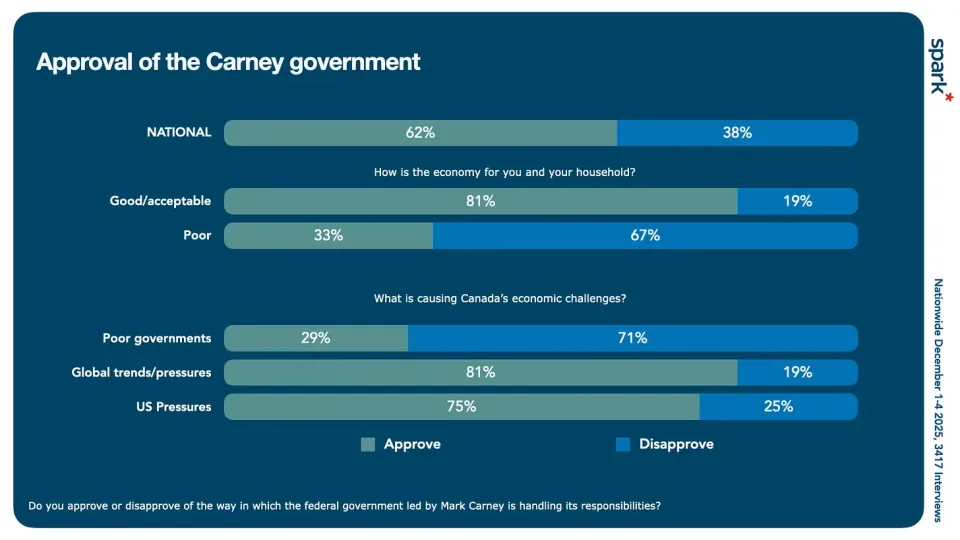
Satisfaction with the Carney government is up 3 points to 62% in our latest Spark Insights survey. (Nationwide, online, 3417 Canadians, fielded December 1-4th.)
You might ask, how is this possible, even as economic uncertainty persists and the cost of living remains a pain point. It has to do with what people think is causing our economic challenges, and what they think it will take to improve things.
When we asked people what is responsible for economic challenges in Canada, a third (33%) blamed poor government policies.
The majority are split between thinking our problems are a function of global changes and trends (31%), or pressures from the US (36%).
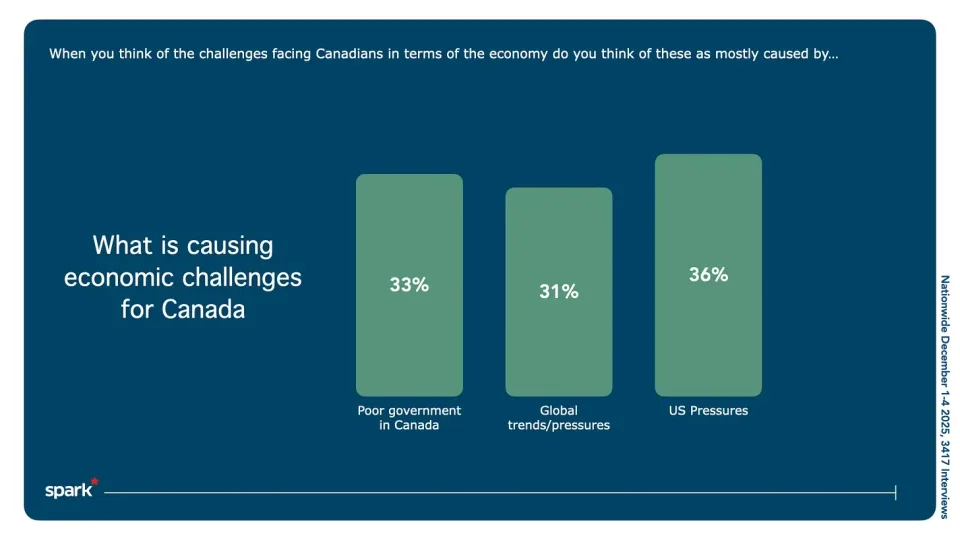
In other words, most people think our economic challenges are coming from outside, rather than self inflicted.
Of course that doesn’t mean that people let any government off the hook for dealing with today’s challenges, but it’s helps explain why many of those who say the economy is a deep source of pain for them, think the Carney government is doing a reasonable job and would prefer a Carney government to a Poliievre government, if an election were held today.
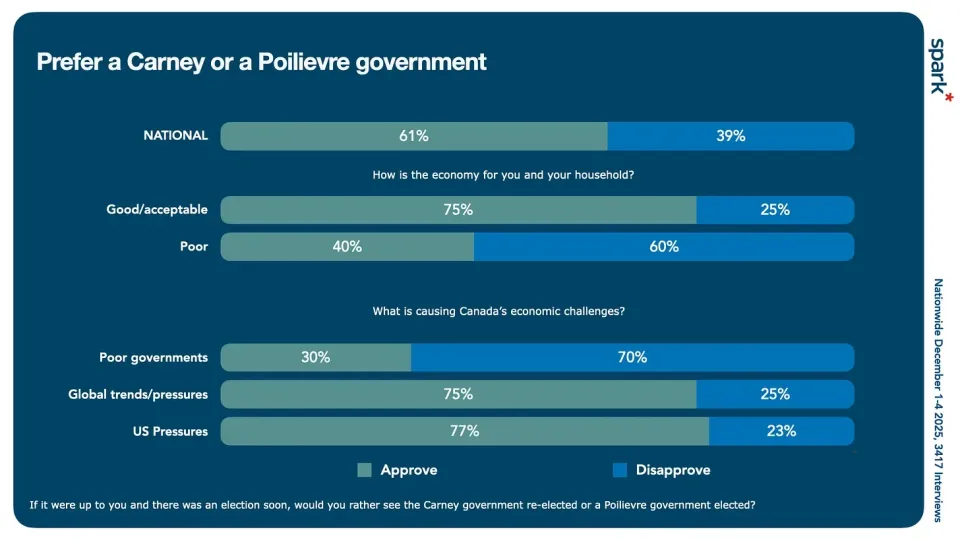
The bottom line? Yes, politics today is still mostly about the economy. But people are looking for a strategy and a leadership skill set that is fit for purpose in a time when our economy is challenged from new and largely external pressures.
Trump was elected President about 400 days ago, weeks later announced that he was going to attack imports from Canada and many other trading partners.
In doing so, he created domino effects that are still dropping - perhaps accelerating - around the world. This turmoil has written a new chapter in Canadian politics, and a fundamentally different take on “It’s the economy, stupid”.
The data referenced were gathered online, with a representative sample of 3,417 adults across Canada, between the dates December 1, 2025 and December 4, 2025.
spark*insights is led by Bruce Anderson, one of Canada’s leading and most experienced public opinion researchers. From polling and research to analysis and guidance, we help organizations, uncover the factors driving or influencing public perception to gain valuable insights into the shape and movement of the landscape.
Tell us your needs, challenge us with your project, get an estimate, come for a coffee and a chat (or reach out for a virtual one)!
Address: 71 Bank Street, 6th Floor, Ottawa, Ontario, K1P 5N2
Email: hello@sparkadvocacy.ca
Telephone: (613) 367-5513
Follow us on social:


© 2026 spark*advocacy Inc., All rights reserved.