
Subscribe for more!
Subscribe to our newsletter for insights and articles on wide ranging issues including reputation management, branding, advertising, awareness, advocacy, and communications. You can unsubscribe anytime.
Follow us on social:



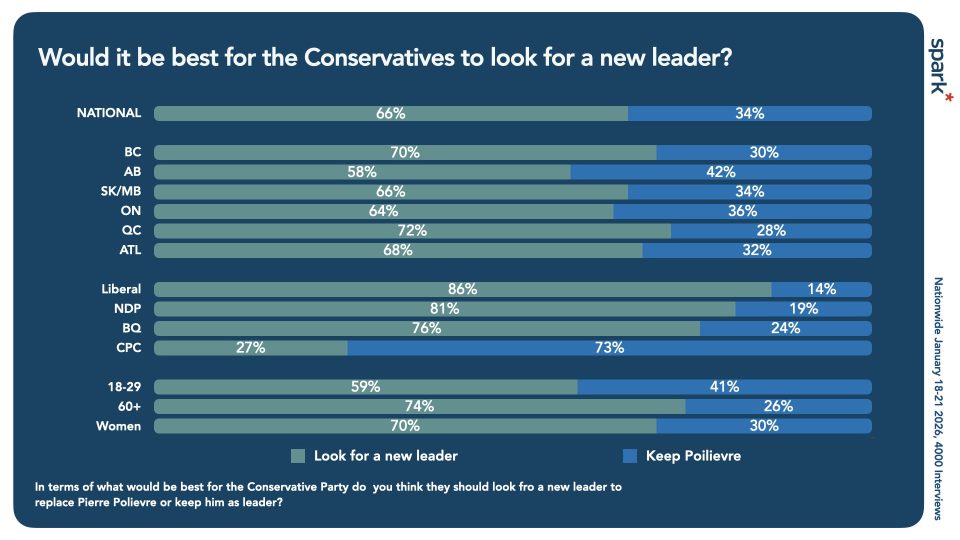
Two thirds think the Conservatives should replace Poilievre, including 27% of Conservative voters.
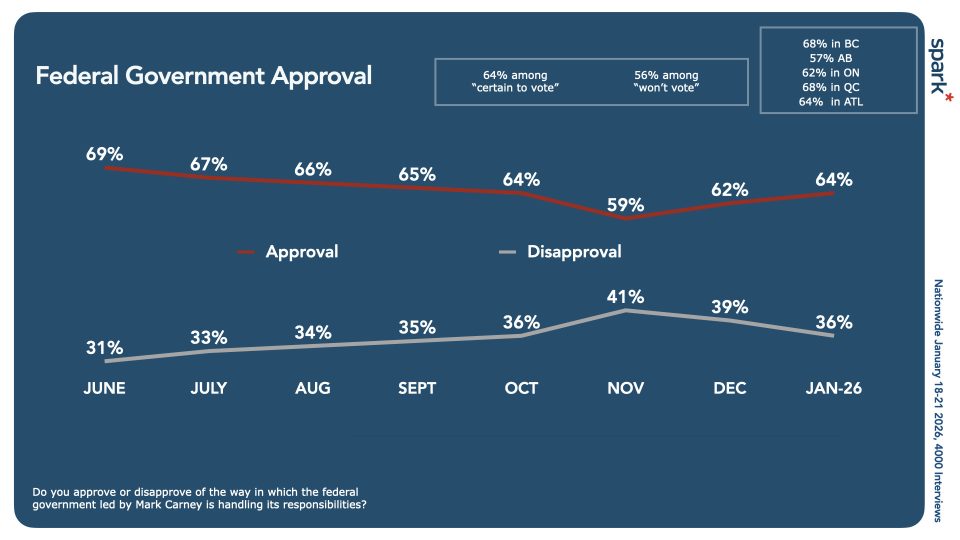
Since a noticeable dip in November, approval levels for the Carney government have reversed course and sit at 64% nationally. Approval is over 66% in every region but Alberta, where it stands at 57%. Approval is over 60% with every age group. These are results from the latest Spark Insights survey, with a nationwide sample of 4,000. Field dates were January 18-21, 2026.
One in four (28%) of those who voted Conservative last year, 69% of those who voted NDP and 68% of those who voted BQ approve of the Carney government.
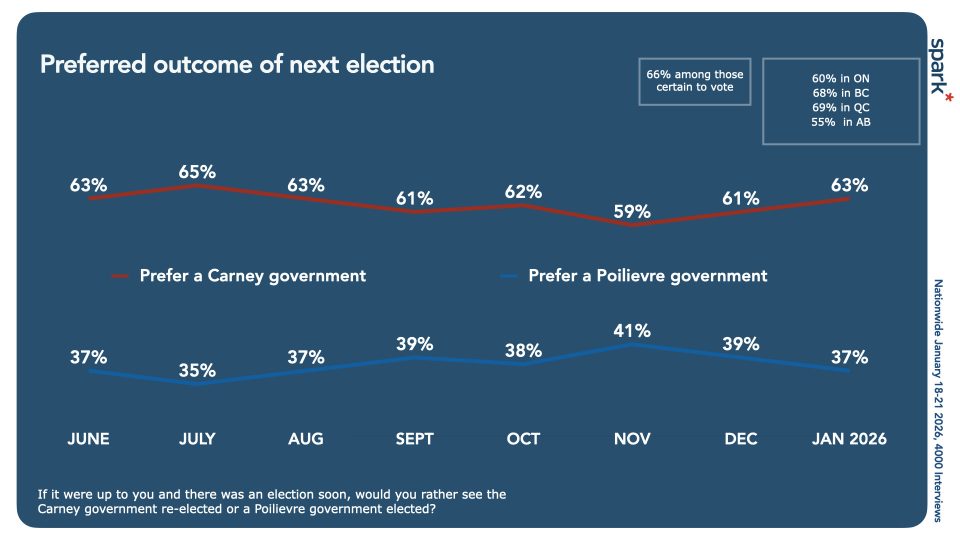
If an election happened now, 63% would prefer to see Carney win, 37% would prefer a Poilievre victory. This is also up 4 points from the November dip. More than half of Alberta voters (55%) would prefer a Carney victory. 80% of those who voted NDP last year and 70% of those who voted BQ feel this way.
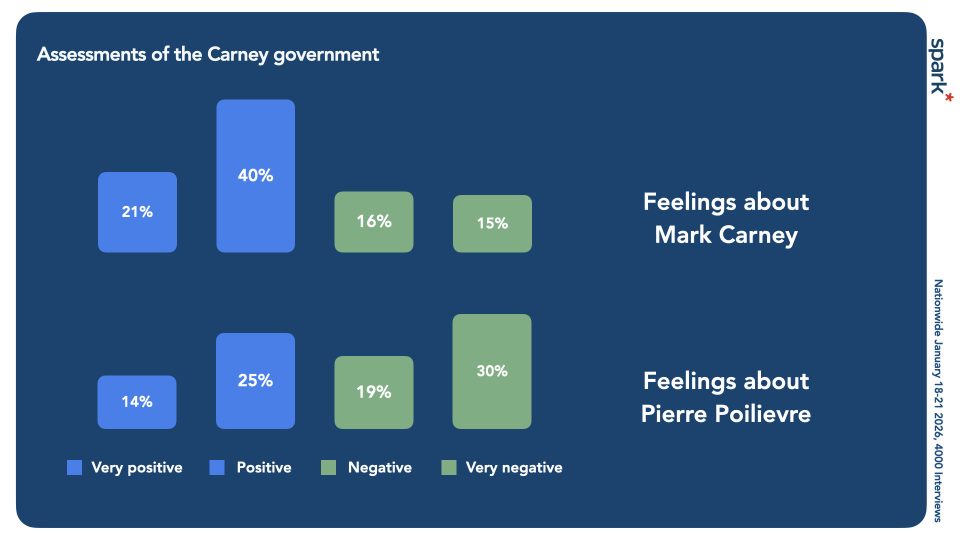
This positive environment for the Carney government is built on several factors.
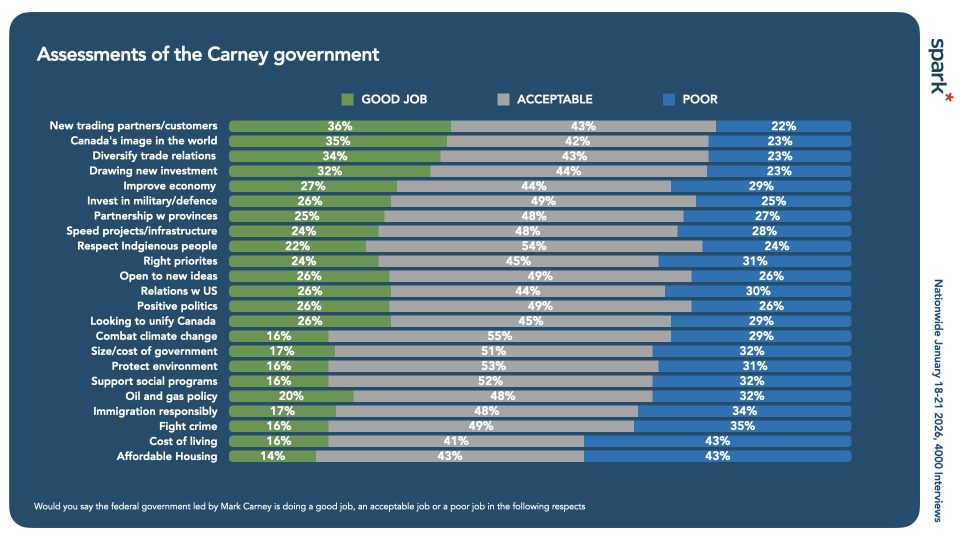
Since December, we see five point improvements on “focusing on the right priorities” “working to improve the economy” “diversifying Canada’s trade” and “handling relations with the US”. The number on housing affordability is stable from last month, as is the case on “doing our part to combat climate change”
In our survey we probed on the Prime Minister’s meeting with President Xi of China and the reduction of tariffs on canola and EV’s. The question we asked was “The Prime Minister recently met with the Chinese president and announced an agreement to reduce tariffs, which will result in some increased canola sales to China and some Chinese electric vehicles being sold in Canada. Based on what you heard or read was this the right thing to do or the wrong thing to do for Canada?”
A total of 78% said they felt it was the right thing to do including 77% in the prairie provinces, and 75% in Ontario. A majority (56%) of those who voted Conservative last year also believe it was the right step, as did 84% of NDP voters and 85% of BQ voters.
As Parliament resumes in a frosty Ottawa January, the mood of the country is tender, tentative, and public stress levels are extraordinarily high.
A stunning 79% say “I feel overwhelmed by the world as it is today”, including 83% among women and 85% among those under 30. People fear “things will never again feel settled in the world” (78%) and 65% “expect there will be a world war in the next 10 years”. 80% feel “America can no longer be trusted”. This includes 86% of Conservative voters.
Given all of that, it’s a fair bet Canadians are in no mood for an election they don’t need.
The government is given room to run and pursue the economic agenda it has laid out.
That’s not the same as people feeling happy - it’s more like people feeling determined to follow a path that seems like the only one that makes sense, and a leader who they have some confidence in.
Voters don’t want politics as usual from opposition parties. Conservative positions on China and the US seem vague, incoherent or detached from the views of mainstream voters. Poilievre was positioned as a change agent in a battle against Justin Trudeau’s 10 year old government - but today Carney is seen as driving change, while Poilievre finds himself with a more than 20 year career as an Ottawa politician and no resume of accomplishments outside of politics.
Small wonder that many voters think the Conservatives could find - or at least should try to find - someone who is a better fit for the times.
The data referenced were gathered online, with a representative sample of 4,000 adults across Canada, between the dates January 18, 2026 and January 21, 2026.
spark*insights is led by Bruce Anderson, one of Canada’s leading and most experienced public opinion researchers. From polling and research to analysis and guidance, we help organizations, uncover the factors driving or influencing public perception to gain valuable insights into the shape and movement of the landscape.
Tell us your needs, challenge us with your project, get an estimate, come for a coffee and a chat (or reach out for a virtual one)!
Address: 71 Bank Street, 6th Floor, Ottawa, Ontario, K1P 5N2
Email: hello@sparkadvocacy.ca
Telephone: (613) 367-5513
Follow us on social:


© 2026 spark*advocacy Inc., All rights reserved.