
Subscribe for more!
Subscribe to our newsletter for insights and articles on wide ranging issues including reputation management, branding, advertising, awareness, advocacy, and communications. You can unsubscribe anytime.
Follow us on social:



spark* data reveals that Mark Carney's popularity is partly due to Canadians seeing something they thought was no longer possible in politics - bringing people together across dividing lines.
It rarely rates a mention when polling asks “what’s the most important issue”, but only because people thought nothing could be done about it. I’m talking about polarization in politics and by extension, in society more broadly.
Have a conversation with friends and acquaintances about the state of the world, and it often doesn’t take long before someone will mention their dismay at how intense and stressful social divisions seem to be.
In politics, it’s been fashionable to rage farm long before the term was invented.
There are a number of reasons why Mark Carney’s political fortunes have strengthened in 2026.
The most obvious are his determined focus on creating a stronger and more resilient economy for the long term. Carney’s credentials in economics and his ability to network among global leaders and institutions are widely perceived and appreciated, however, there’s another powerful driver of satisfaction with his leadership.
It has to do with an understated but visible natural setting - to try to walk over or around past dividing lines and rules of political engagement, and instead try to work on solutions with lots of different stakeholders.
As I see it, he has fashioned the broadest and sturdiest relationship with Provincial Premiers since before the patriation of the Constitution. In the House of Commons, MPs from the left and right have felt welcome to join his caucus, and more aligned with his broad, centrist vision for the country.
Elite level accommodation and bridge building might be easy for voters to miss or ignore in today’s attention economy. But Canadians see the effort to bring down the temperature, and focus on their needs rather than a partisan agenda.
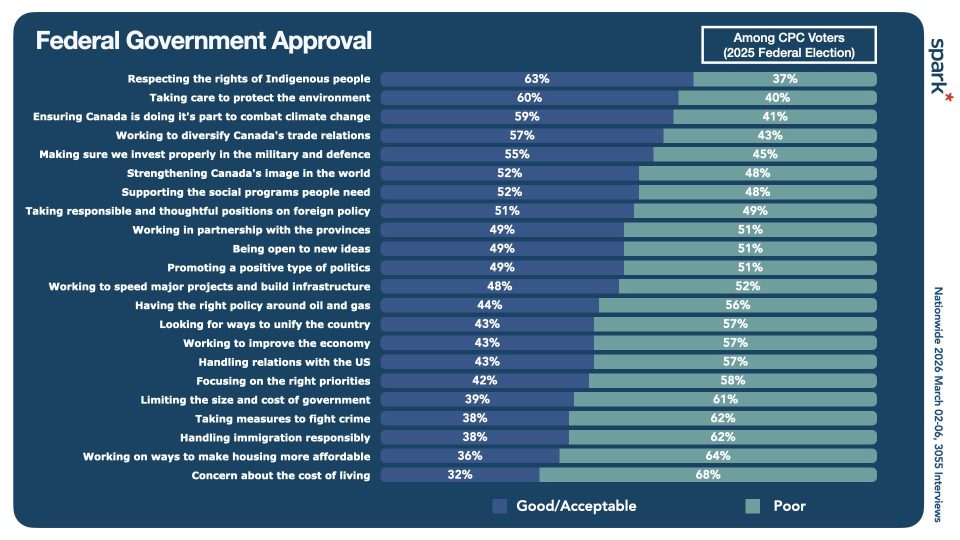
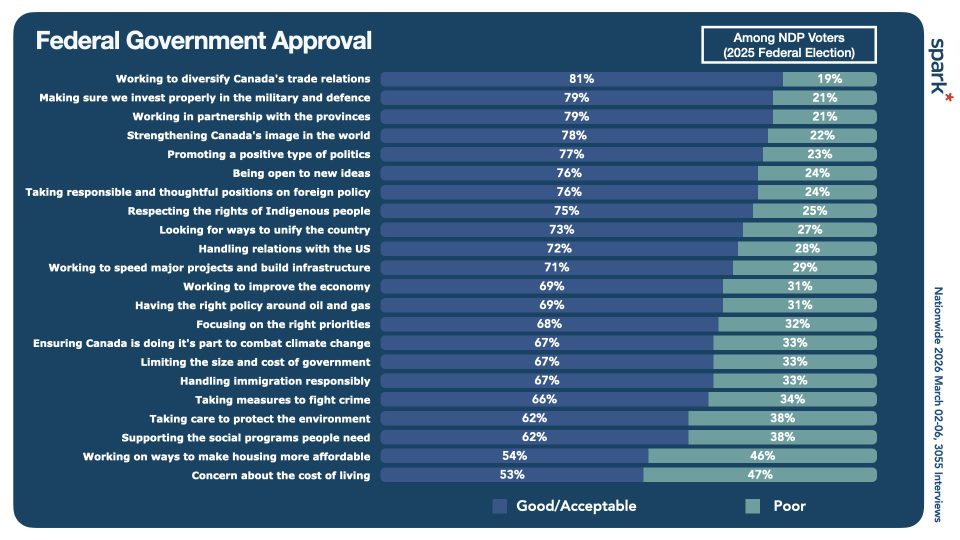
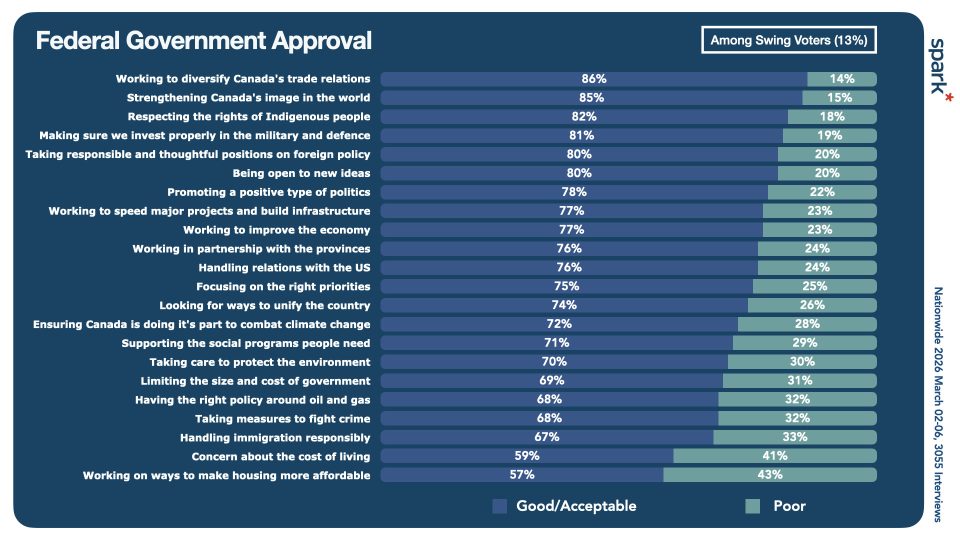
There’s been a dramatic weakening in the relationship between partisan choice and assessments of the federal government. A year after Carney took office, many of those who voted for a different party feel pretty satisfied with his approach.
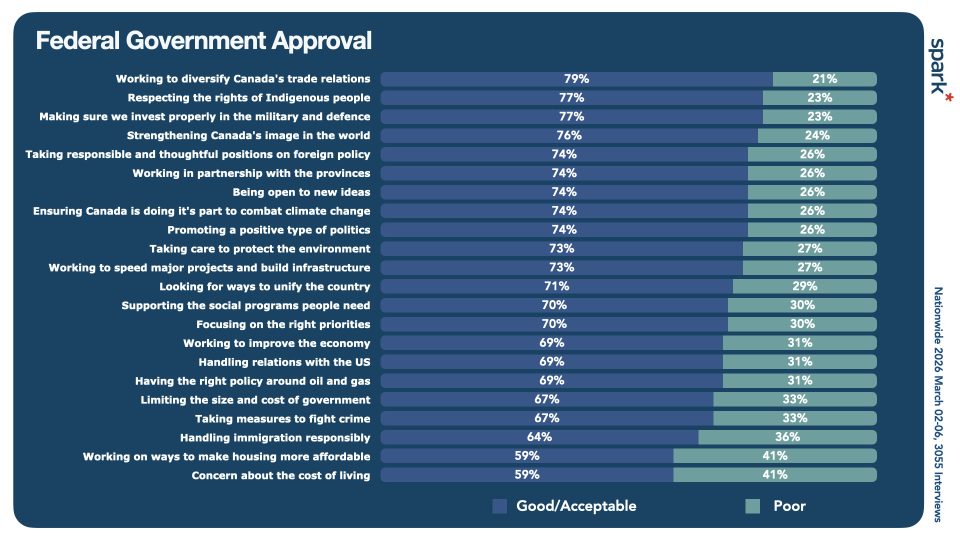
In our latest polling at Spark Advocacy, we asked respondents to rate the Carney government’s performance on 22 different items. Answer options were “good” “acceptable” or “poor”.
In recent years, it’s become customary to see deep hostility towards the Harper government among Liberal voters and the inverse when it came to Conservative voters towards Justin Trudeau.
That’s not what’s happening today.
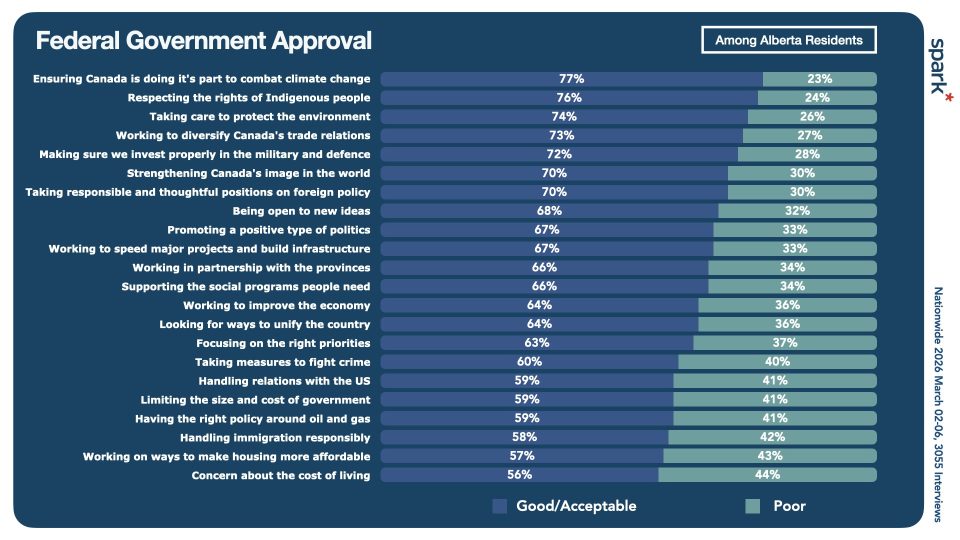
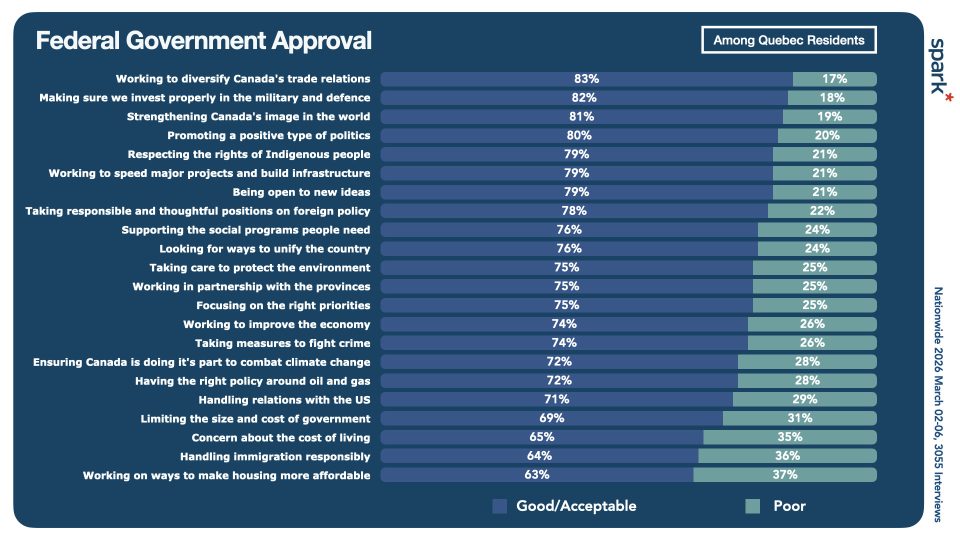
Some might look at these findings and assume that they are a product of policy choices - and that’s certainly a factor.
However, most voters don’t consume politics in much detail - they see Carney’s effort to diversify our trade relations, invest in defence, build infrastructure, and strengthen Canada’s voice in the world.
Basically, they see someone working hard, on things that they believe are important.
But I believe there’s another factor deserves more attention in understanding today’s assessments of the government and the Prime Minister - he looks like someone who prefers to bring people together, rather than relishing the divide and conquer formula for politics.
Three quarters of those in our survey think he tries to promote a positive type of politics. Half of those who voted Conservative last year feel that way, so do 77% of NDP voters, 78% among swing voters, 67% in Alberta and 80% in Quebec.
Observers of politics got used to imagining that nice guys would always finish last. Advice tended to favour relentlessly pugilism, and the creation of friction and triangulation. In today’s world, where people see far more fracturing and worry about it deeply, a leader whose first instinct is to have an open mind and look for common ground, is highly valued.
spark*insights is led by Bruce Anderson, one of Canada’s leading and most experienced public opinion researchers. From polling and research to analysis and guidance, we help organizations, uncover the factors driving or influencing public perception to gain valuable insights into the shape and movement of the landscape.
Tell us your needs, challenge us with your project, get an estimate, come for a coffee and a chat (or reach out for a virtual one)!
Address: 71 Bank Street, 6th Floor, Ottawa, Ontario, K1P 5N2
Email: hello@sparkadvocacy.ca
Telephone: (613) 367-5513
Follow us on social:


© 2026 spark*advocacy Inc., All rights reserved.