
Subscribe for more!
Subscribe to our newsletter for insights and articles on wide ranging issues including reputation management, branding, advertising, awareness, advocacy, and communications. You can unsubscribe anytime.
Follow us on social:


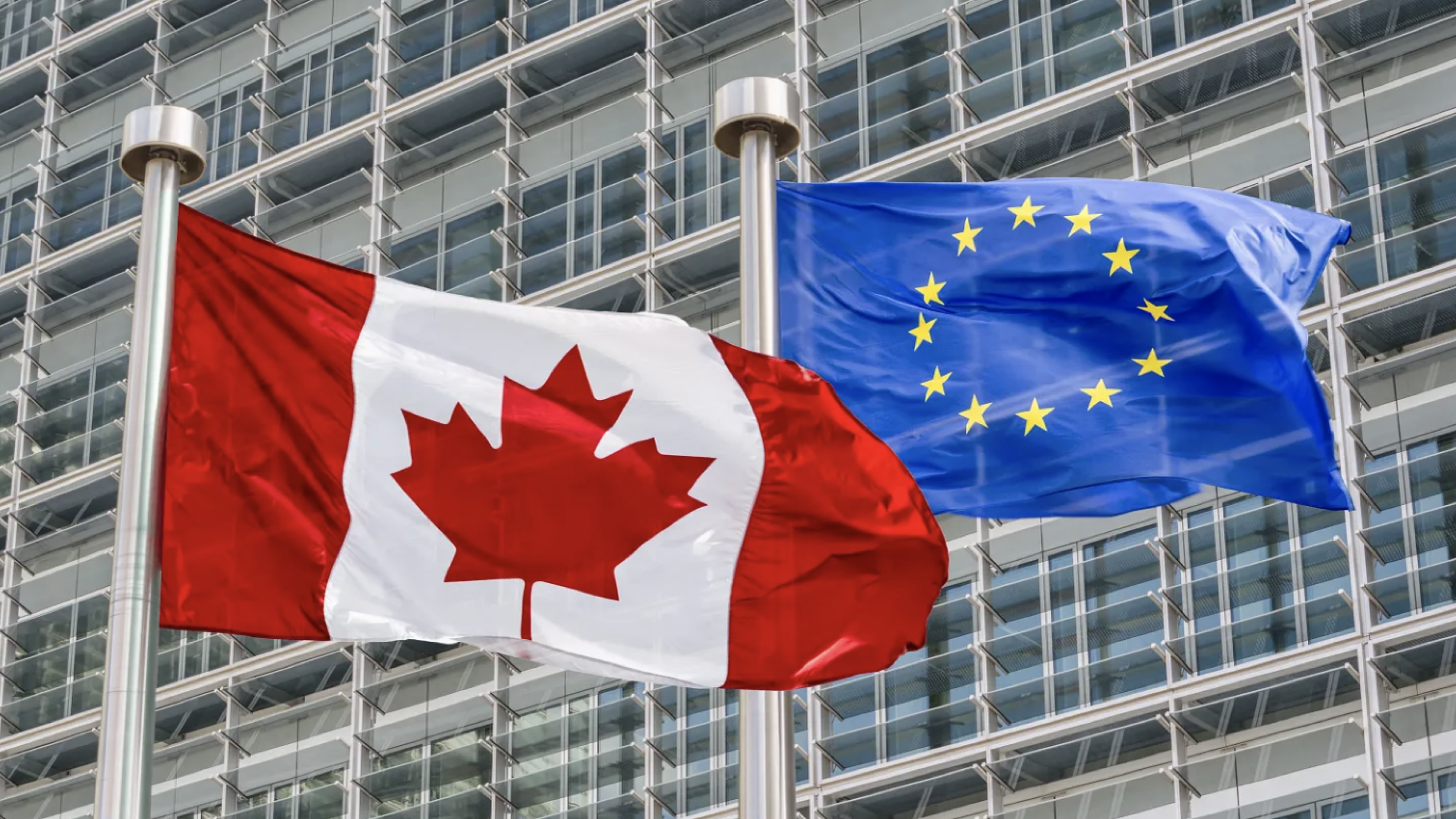
Two thirds think the UK made a mistake getting out of the EU.
The disruption that President Trump has caused in international relationships and markets has prompted a lot of people to open their minds to new possibilities, and new directions.
Prime Minister Carney’s speech in Davos gave flight to the idea that middle powers should look for ways to work together and support one another. While he has also indicated that membership in the EU is not his intent, “not the path we are on” there is a lot more attention being paid both in Europe, and in Canada for how to become more closely aligned for economic and security purposes.
The constant hostility Trump shows towards NATO have helped fuel Canadians’ desire for a future where the choices of a US administration have less ability to impact our lives in Canada.
In a survey of 4000 people that we conducted in March, we asked this question: “there has been some talk lately about the idea of Canada joining the European Union Do you think this sounds like a good idea, an idea worth exploring more, or a bad idea?”
A quarter (25%) of those surveyed said it was a good idea, and 17% said it was a bad idea - the rest said it was worth exploring more. (57%)
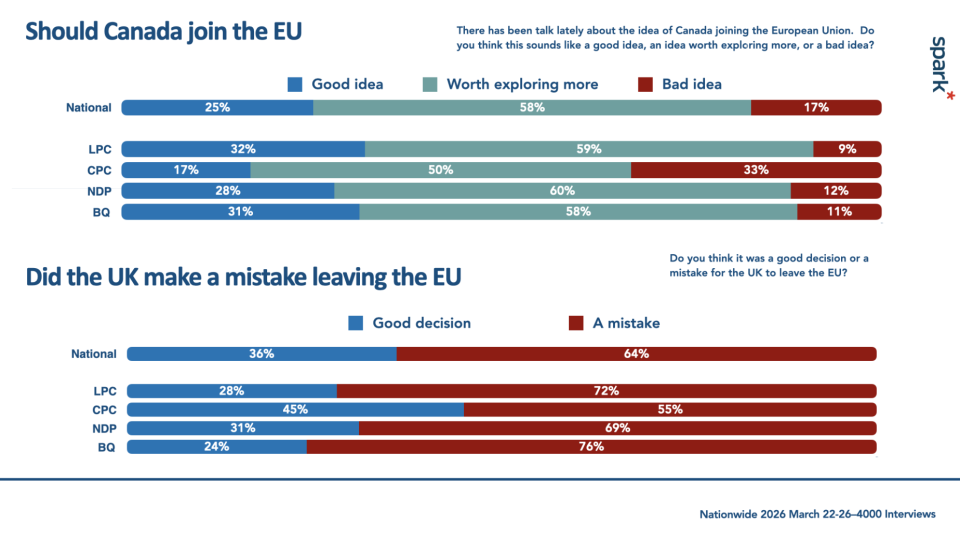
Outright opposition to the idea peaked at 23% in Alberta and 30% among Conservative Party voters. In other words, majorities in every region, across all party lines, and every generation felt it was at least an idea worth considering.
We also asked whether respondents thought “it was a good decision or a mistake for the UK to leave the EU.” Two thirds (64%) said it was a mistake. Again, majorities in every region and across all parties felt this way, although Conservative voters (55% mistake) were the most divided.
There are a number of things that influence these opinions, but one of them in my mind is that isolationism is not really in fashion among Canadians, and multilateralism is not a dirty word.
Canadians see the country as much better off having access to sell our products into global markets, and believe we are better able to deal with security threats and global issues like climate change - when we work with other countries.
“Davos” was treated as a dirty word by Conservative leader Poilievre. His Deputy Leader Andrew Scheer was an ebullient cheerleader for Brexit, but neither of these positions has anywhere near the cachet they might have hoped for.
In the last several months, Conservatives also spent political capital criticizing the Prime Minister for travelling the world, only to find that the large majority of Canadians felt quite differently, and said these trips should be a priority.
Canadians’ support for multilateralism is not a matter of pragmatism, not ideology. Conservatives’ aversion to multilateralism often comes off sounding like a conspiracy theory about the world, not a better way to help Canadian workers.
This is yet another aspect of our politics where Donald Trump has affected the chemistry in Canada - and another example of how MAGA politics has presented a division within the Conservative voter pool, too.
spark*insights is led by Bruce Anderson, one of Canada’s leading and most experienced public opinion researchers. From polling and research to analysis and guidance, we help organizations, uncover the factors driving or influencing public perception to gain valuable insights into the shape and movement of the landscape.
Tell us your needs, challenge us with your project, get an estimate, come for a coffee and a chat (or reach out for a virtual one)!
Address: 71 Bank Street, 6th Floor, Ottawa, Ontario, K1P 5N2
Email: hello@sparkadvocacy.ca
Telephone: (613) 367-5513
Follow us on social:


© 2026 spark*advocacy Inc., All rights reserved.