
Subscribe for more!
Subscribe to our newsletter for insights and articles on wide ranging issues including reputation management, branding, advertising, awareness, advocacy, and communications. You can unsubscribe anytime.
Follow us on social:


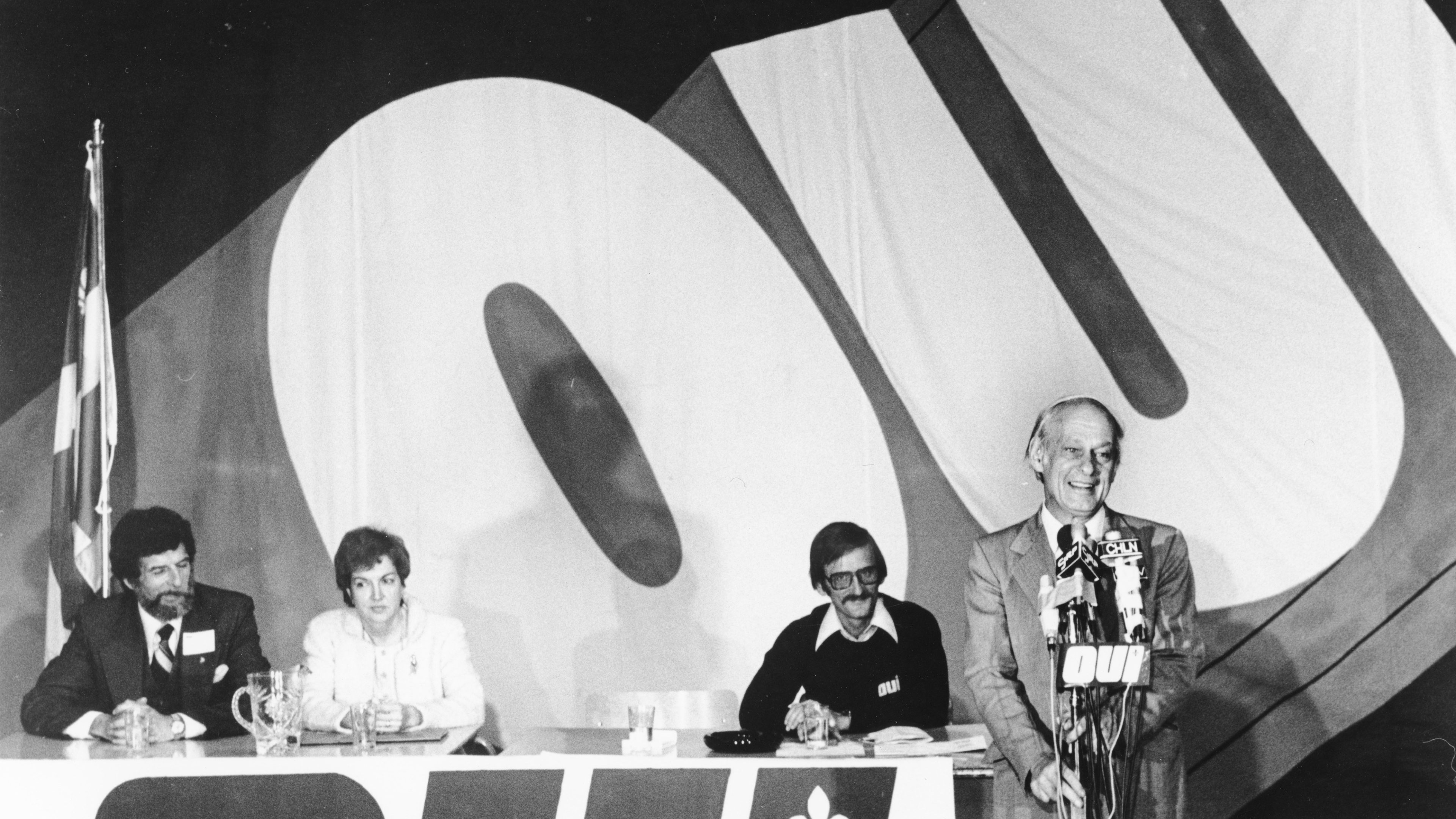
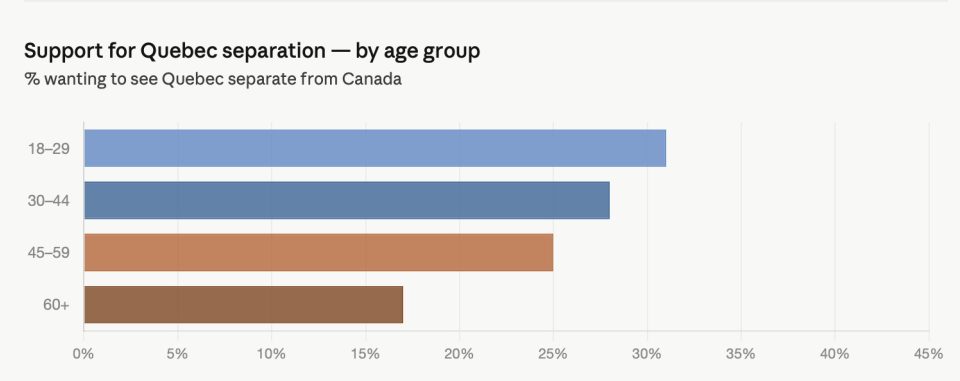
But young people are more tempted by the idea, and federalists should concentrate on narrowing that generation gap.
In 1980, 40% of Quebecers voted to separate. Fifteen years later, 49% took that position in a second referendum. Fast forward 30 years, and the Parti Quebecois is promising a third referendum if they win the next election, a promise that is looking more like a millstone for Paul St. Pierre Plamondon, the PQ leader.
“Winning conditions” for separatism requires a confidence that the dream of a sovereign Quebec would carry all of the aspirational positives and few if any meaningful negative consequences. It helps also if there is an unpopular federal government, especially one flexing its muscles in areas of provincial policy.
In a Spark survey late last year, we found a lot of Quebecers who like the concept of “sovereignty” feel so unnerved by the amount of geopolitical disruption in the world, that they would not consider going down that road today.
In our latest Spark Advocacy survey, (sample of 785 people, online in Quebec, April 2-6, 2026) only one in four (24%) Quebecers want to see Quebec separate from Canada, as of right now. 61% say they don’t, and 15% say “I’m not sure”. Even half (46%) of those who voted BQ last year do not think Quebec should separate, at least not now.
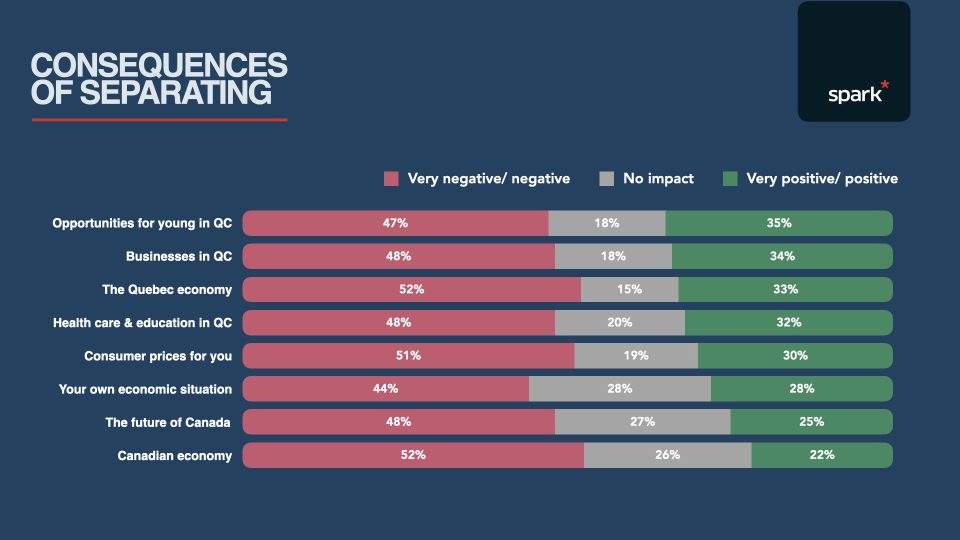
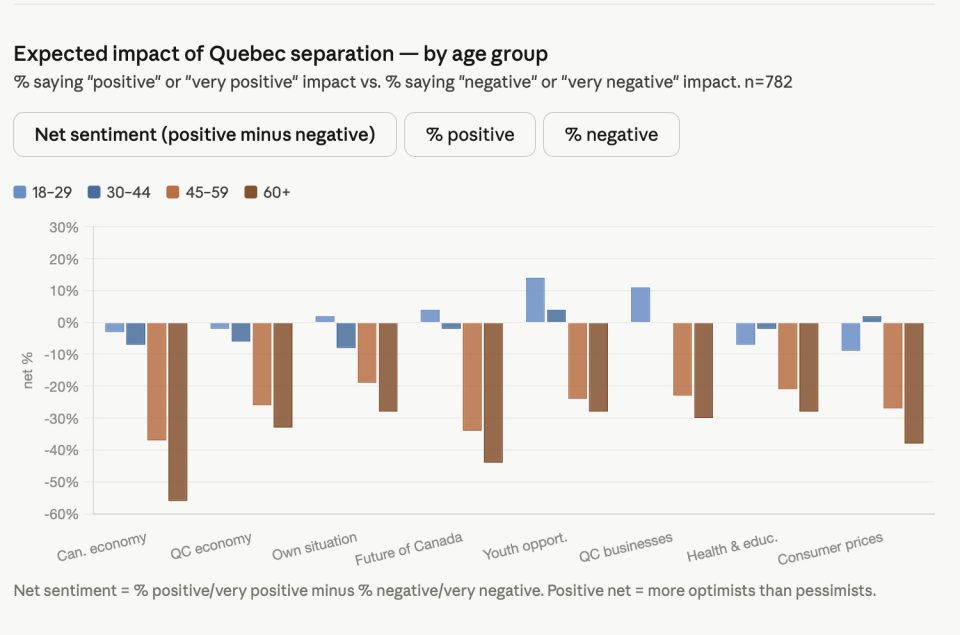
People are more likely to see negative impacts on the economy of Quebec, health and education services, the cost of living, opportunities for young Quebecers.
Only about a third see more upsides than downsides.
This skepticism is no doubt helping fuel the rising fortunes of the Quebec Liberal Party, who are promising no referendum.
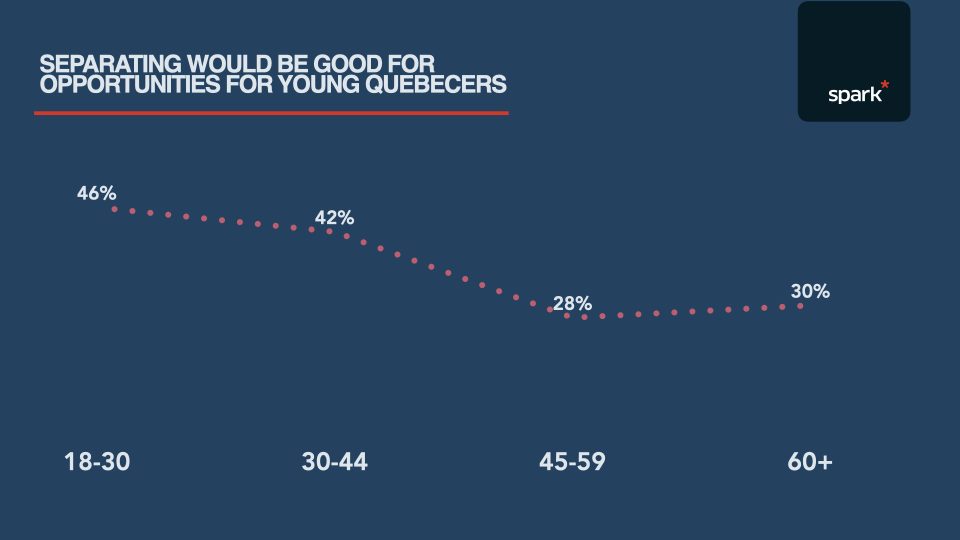
If there’s a source of concern for federalist campaigners it is about young people. Among those under 30, 36% say separation would improve opportunities for the young, while only 32% say things would be worse.
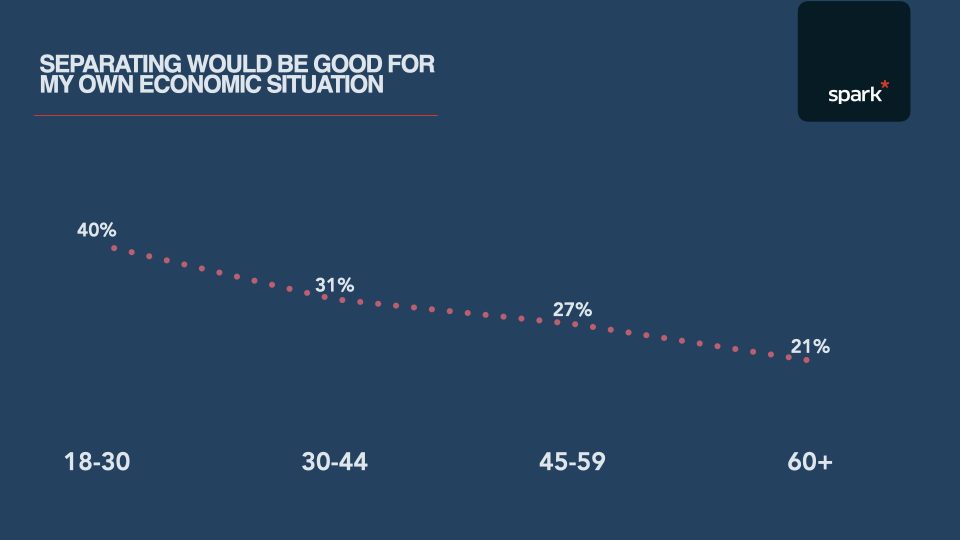
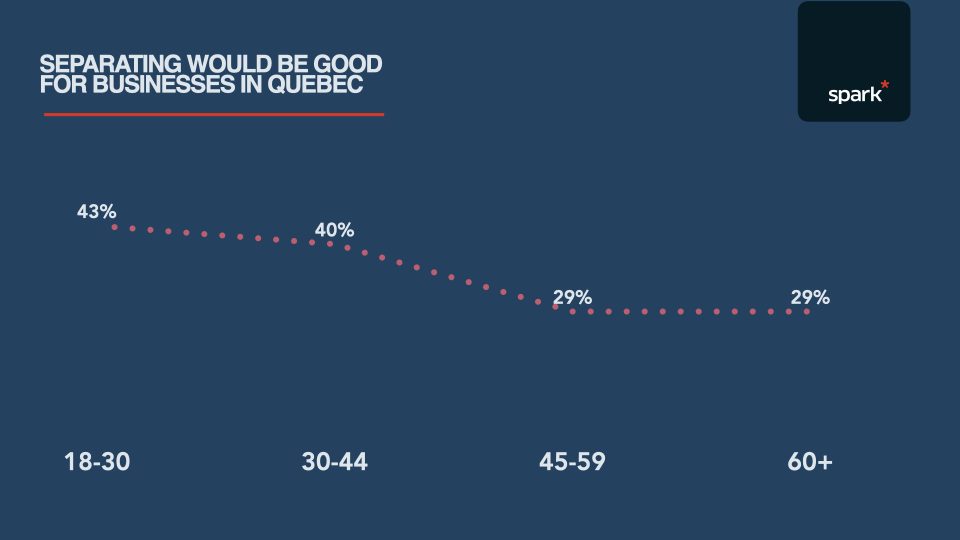
The same pattern is evident on a range of other questions - young people are less likely to fear negative consequences and more inclined to think things will be better, at least compared to how older generations feel.
And to be more precise, the challenge is most acute with young, male, francophones. They are almost twice as likely as young, female francophones to embrace separatism.
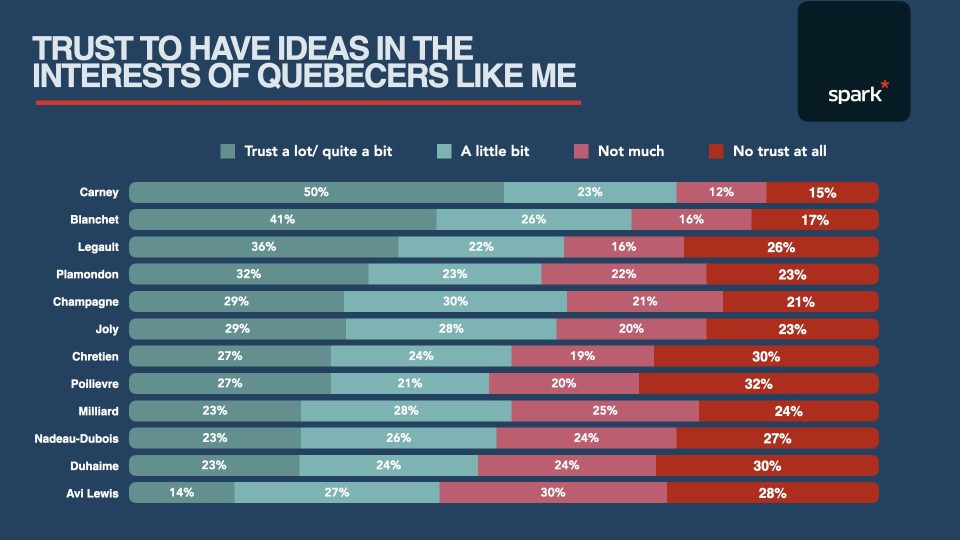
If there will be a referendum in Quebec, the arguments will matter, but so too will the trust that people have in different stakeholders.
Of the 12 names that we tested, the most trusted voice was Mark Carney, followed by Yves Francois Blanchet, and Francois Legault.
Paul St. Pierre Plamondon was next, more or less tied with two high profile Quebec federal Ministers, Industry Minister Melanie Joly and Finance Minister Francois Philippe Champagne.
Just under half indicate some trust in Pierre Poilievre. Provincial Liberal leader Charles Milliard is in the same range.
Looking back on the two previous referendums, it’s important to remember that Pierre Trudeau and Jean Chretien had both been important and different catalysts. Trudeau campaigned for a no vote and promised constitutional reform in exchange.
Chretien’s outing was more troubled and he ended up making a somewhat desperate pitch near voting day, promising constitutional reforms that in the end, he was unable to deliver.
As of now, the current federal Prime Minister is not in a similar situation, he is well regarded and his agenda is supported by two-thirds of Quebecers. Like everywhere else in the country, people in Quebec are concerned about US trade policy and the destabilizing aspects of the Trump presidency. Constitutional change has not been on his agenda, or a part of the mainstream political conversation today.
If the PQ wins and launches a referendum, separatists will find they do not have an easy sell.
But at the same time, federalists can’t afford to be complacent or over-confident, given the way young Quebec men are seeing things. They aren’t looking to litigate constitutional issues. They approve of the Carney government, and they like him personally. There isn’t a separatist firebrand orator that is appealing to them. They lean towards wanting a centre-right government, not centre-left - but they aren’t hard right.
Mostly, they are less convinced that separating would create personal economic risk and more inclined to think things might be better than what they see now, in terms of opportunities.
The debate - should it happen - won’t be like the last ones.
A federalist vote probably won’t turn on a promise of a constitutional adjustment. This doesn’t feel like the next chapter of the ‘quiet revolution’ drawing on longstanding language and cultural frictions.
Instead, it feels like a question of “if the economic status quo isn’t good enough, would separatism make it better, or worse”.
spark*insights is led by Bruce Anderson, one of Canada’s leading and most experienced public opinion researchers. From polling and research to analysis and guidance, we help organizations, uncover the factors driving or influencing public perception to gain valuable insights into the shape and movement of the landscape.
Tell us your needs, challenge us with your project, get an estimate, come for a coffee and a chat (or reach out for a virtual one)!
Address: 71 Bank Street, 6th Floor, Ottawa, Ontario, K1P 5N2
Email: hello@sparkadvocacy.ca
Telephone: (613) 367-5513
Follow us on social:


© 2026 spark*advocacy Inc., All rights reserved.