
Subscribe for more!
Subscribe to our newsletter for insights and articles on wide ranging issues including reputation management, branding, advertising, awareness, advocacy, and communications. You can unsubscribe anytime.
Follow us on social:


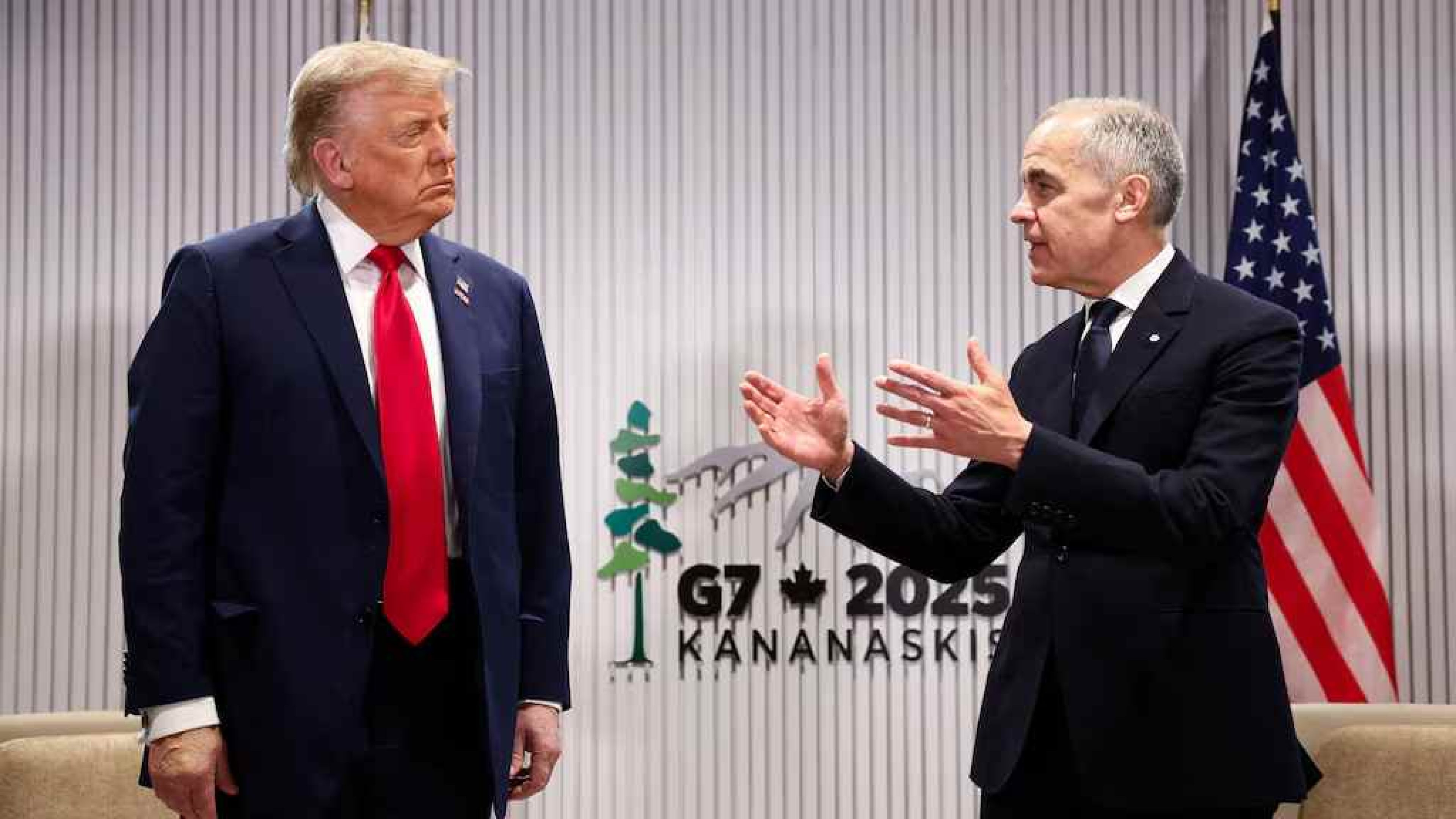
Only 27% think - in the end - Canada will be worse off than before the Trump tariff conversation started.
For more than a year, Canadians have paid a great deal of attention to the Trump Administration and the trade conversation the US President has triggered with his wave of tariffs and talk of annexation.
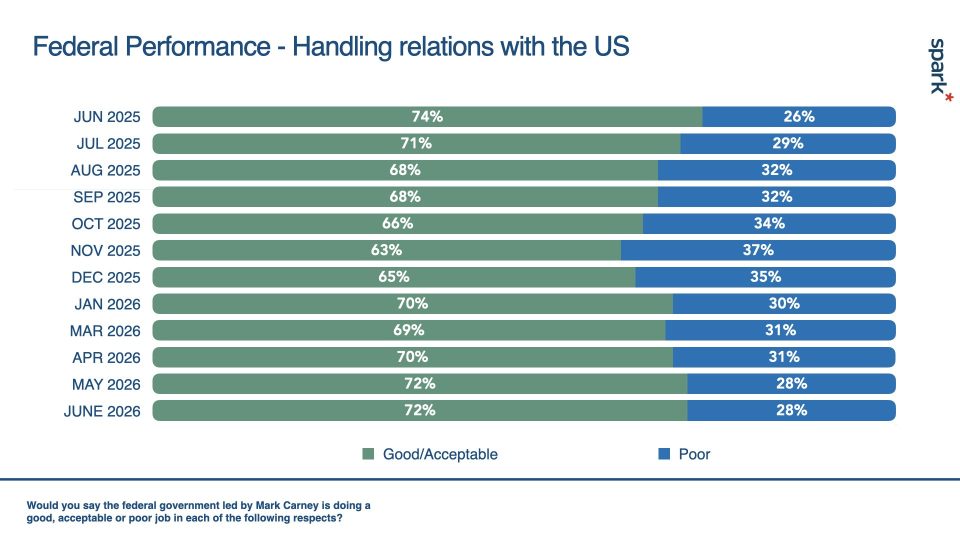
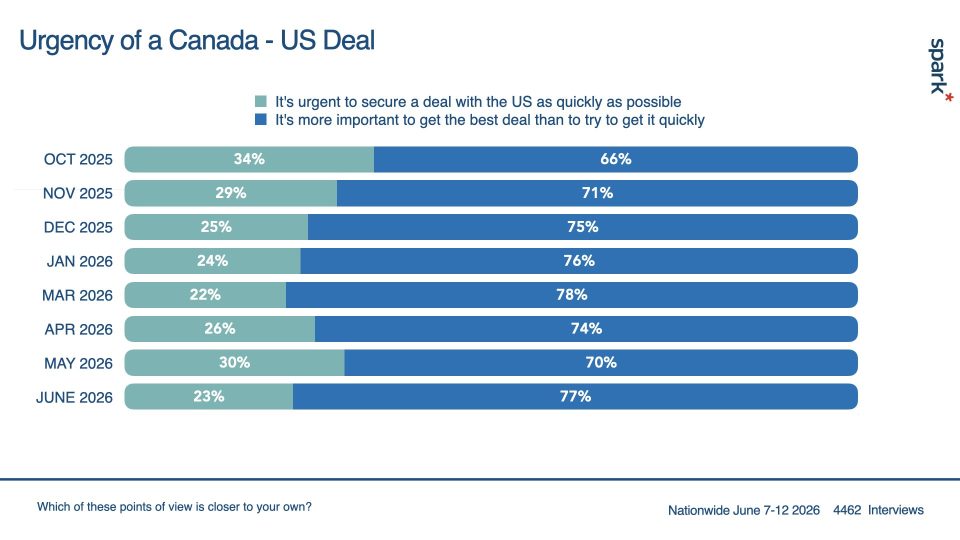
In our latest Spark Advocacy survey (nationwide, June 7-12, 4462 cases) Canadians reveal that the year of drama has made them more patient and confident about how things will work out for the country.
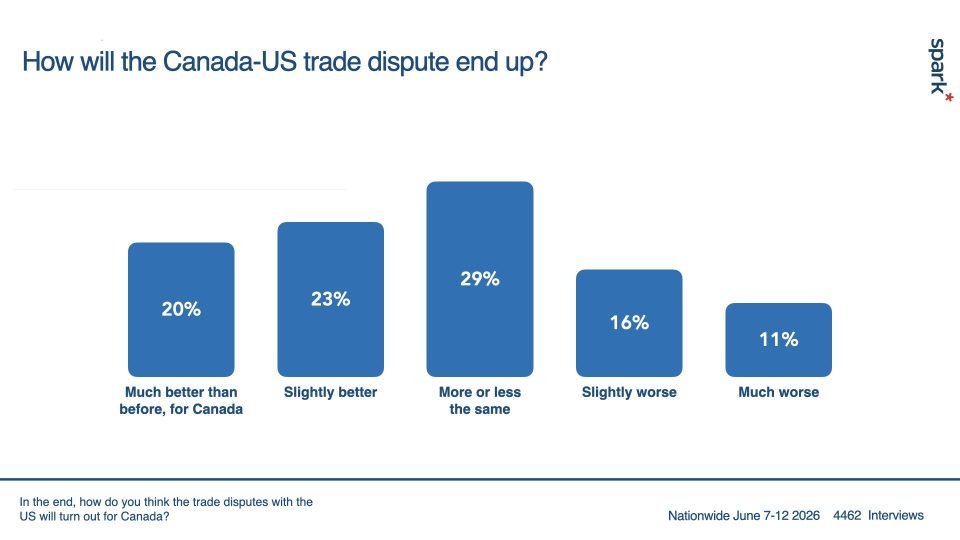
Underpinning this patience is a general confidence that things will turn out all right. When asked “in the end, how do you think the trade disputes with the US will turn out for Canada?” 43% say Canada will end up better off than before the dispute started, and 29% say more or less the same. Just 27% believe Canada will end up worse off - including just 11% who say we will be much worse off.
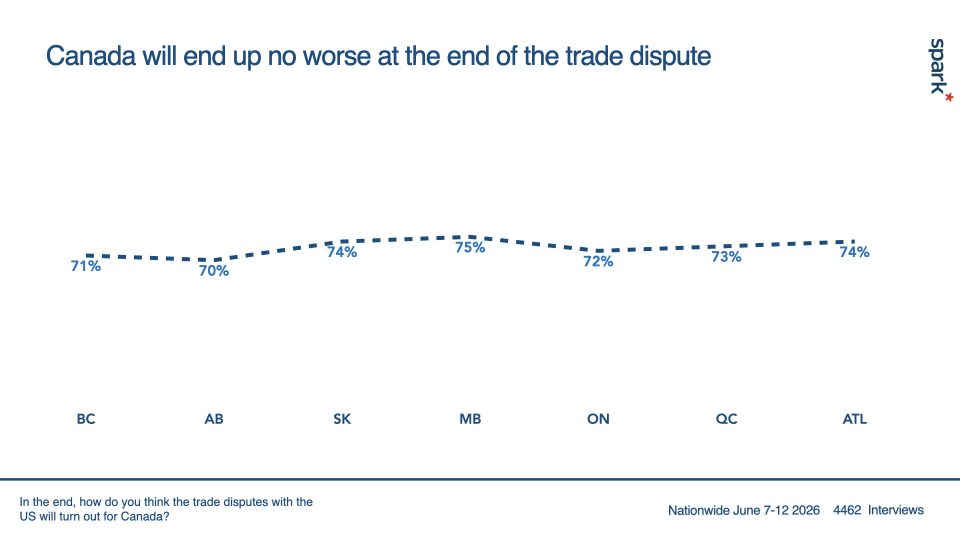
How is it possible that the level of anxiety and urgency that was evident in January 2025 has shifted so much?
In my view, there are several factors that are contributing.
First, many people sense that Trump’s tariff policies have been chaotic, temperamental, and that his “deals” with other countries have been fragile, to say the least. Canadians understand the risk of seeming to want a deal so badly with someone who can’t be trusted to keep their part of a bargain.
Second, Trump’s tariff agenda has created resistance in the US, and may not survive past Trump’s Presidency, or perhaps even much beyond the mid-terms this fall. US courts have pushed back on the tariff agenda, Americans are tired of inflation and do not believe that tariffs will lead to a great reshoring manufacturing renaissance.
Canadians sense that Trump’s power may be waning, that Americans don’t like these tariffs, nor the constant friction with allies.
Third, except for certain sectors, the impact on the Canadian economy so far has not been as dramatically negative as people feared. Much of the country’s trade remains protected under USMCA. There is a growing acknowledgement in America that Canada “has cards”, especially when it comes to aluminium and potash, and that Canadian lumber and energy would be very hard to replace. Canadians sense that our negotiating position has not weakened, but possibly firmed, when it comes to the fundamentals of how the trading relationship works.
Finally, Canadians see a federal strategy which is a combination of aggressive and ambitious efforts to diversify our trade and make our economy less dependent on the US, while at the same time, approaching the US as an ally and trading partner, with constructive ideas, but no sense of desperation. People are optimistic that the world wants to invest in Canada and do more trade with Canada, even if this transition will take time.
Trump has fought with Meloni, Macron, Starmer, Werz. He’s insulted and threatened and bullied them. Skirmishes with Carney have been qualitatively different. In the end, Canadians sense that the world is not going to capitulate to Trumpism.
No doubt Carney’s Davos speech caused frustration among Trump’s close circle. It laid bare the hypocrisy of Trump’s position: on the one hand he doesn’t want to “carry” all these other countries that he says have depended too much on the US. And then, when other countries talk about doing things on their own or without the US as leader, he reminds us not to forget that “Canada lives because of the United States.”
Canadians believe that amidst all the drama, a strategy of constructive, polite engagement is necessary and will work if in the end, the US decides it wants to stop creating friction with virtually all of its allies.
And whether the US does - or never does - arrive at that point, the rest of us will have been better off working on a different plan.
spark*insights is led by Bruce Anderson, one of Canada’s leading and most experienced public opinion researchers. From polling and research to analysis and guidance, we help organizations, uncover the factors driving or influencing public perception to gain valuable insights into the shape and movement of the landscape.
Tell us your needs, challenge us with your project, get an estimate, come for a coffee and a chat (or reach out for a virtual one)!
Address: 71 Bank Street, 6th Floor, Ottawa, Ontario, K1P 5N2
Email: hello@sparkadvocacy.ca
Telephone: (613) 367-5513
Follow us on social:


© 2026 spark*advocacy Inc., All rights reserved.