
Subscribe for more!
Subscribe to our newsletter for insights and articles on wide ranging issues including reputation management, branding, advertising, awareness, advocacy, and communications. You can unsubscribe anytime.
Follow us on social:



Canadians aren't flinching, panicking or for capitulating in the face of Trump's pressure tactics. Trump's schtick is getting old.
Three weeks after winning the last Presidential election, Donald Trump announced he was slapping a 25% tariff on Canada because US border controls were failing to stop immigrants and fentanyl from coming into the US from Canada.
A few weeks later, he took the conversation in a different direction, describing Canada as a $100 billion subsidy burden on Americans.
In a March 25th 2025 interview he first wheeled out the “nasty” term, saying we were among the nastiest people to deal with. (Historically the rest of the world and most people in his country would tend to put us at the other end of the nasty-nice scale). Trump’s superpower has been naming his opponents and having those images stick. This one won’t. Americans won’t buy it.
On the spectrum of insults that Trump employs, I suppose a case could be made that nasty is one of the milder ones. He’s also said that part of what makes him effective is that he can be nasty - a rare moment of lucid introspection.
Amidst all of the threats and insults, Canadians are alert but nonplussed. Or at least less plussed than they were last year.
Trump’s schtick is getting old.
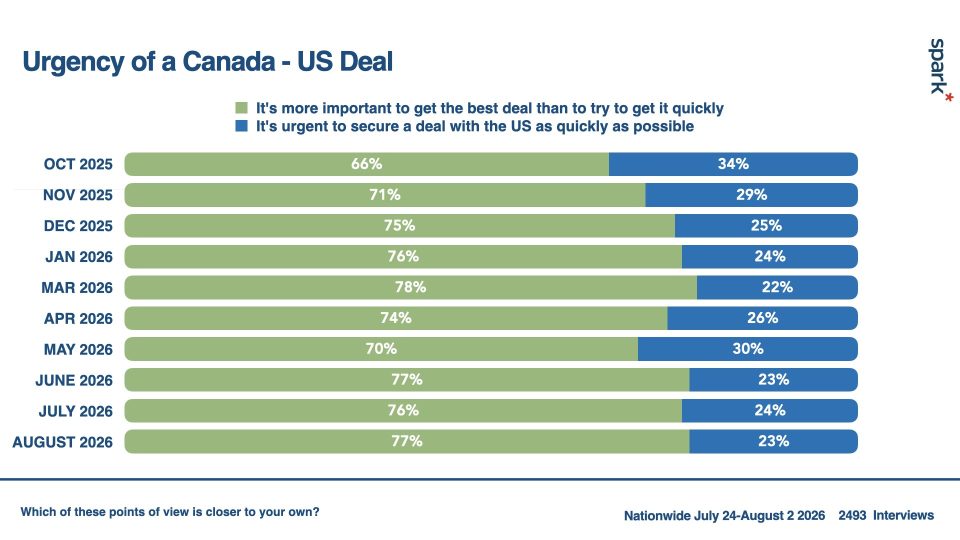
In our latest wave of Spark surveying (Nationwide, online, July 24-August 2, 2026) we found only 23% saying it was urgent to get a trade deal with the US, while 77% said “it’s more important to get the best deal than to try to get it quickly”.
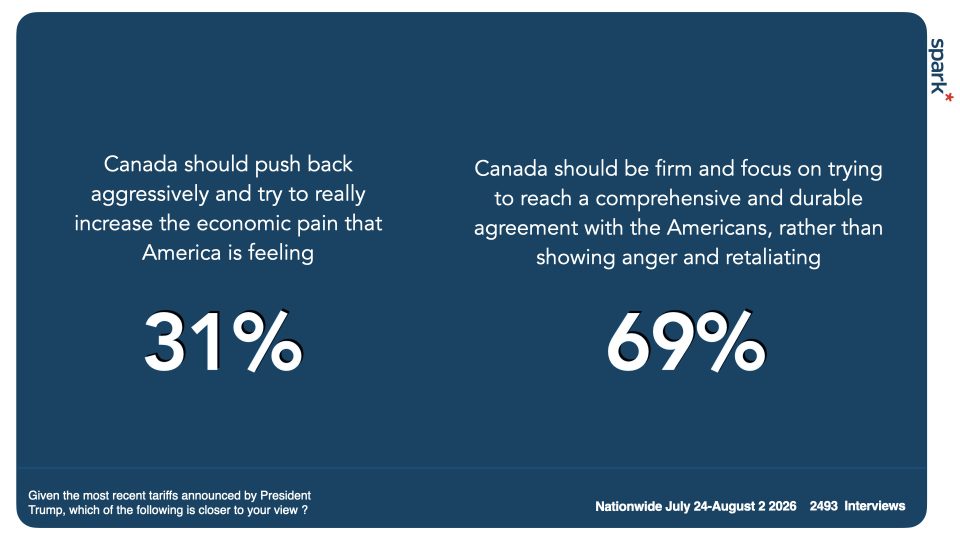
In response to the latest round of tariffs, which could go into effect in a couple of weeks, we offered respondents two choices as to what Canada should do: “push back aggressively and try to really increase the economic pain that America is feeling” or “be firm and focused on trying to reach a comprehensive and durable agreement, rather than showing anger and retaliating.”
By a more than 2:1 ratio, Canadians prefer “firm and focused”.
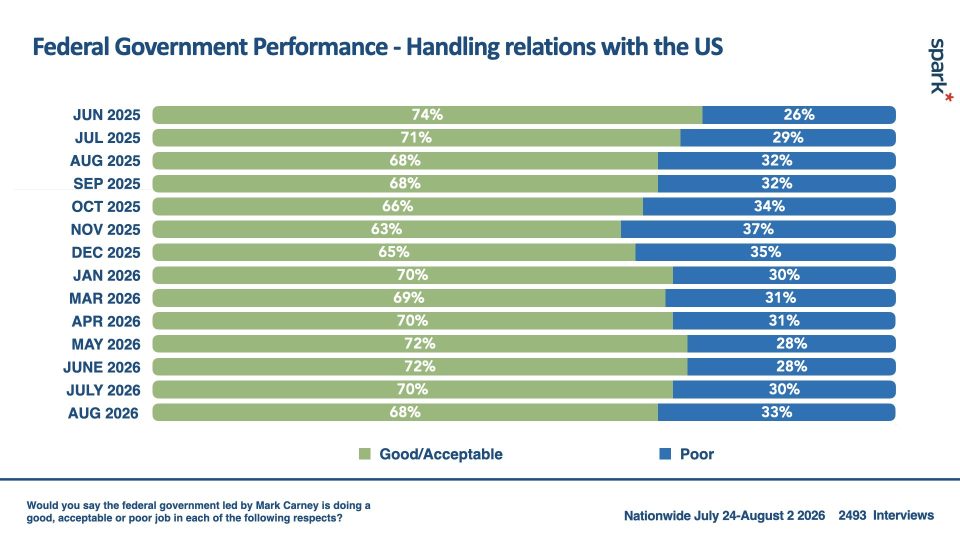
Today, 68% say the Carney government is doing a “good” or “acceptable” job at handling relations with the US.
Remarkably, this includes most of those who voted for the Bloc (56%) or the NDP (78%) and almost half (42%) of those who voted Conservative last year.
Conservative voters are not exactly rallying to the messages of Pierre Poilievre, and MPs Shuvaloy Majumder and Jamil Jivani about Carney failing in this part of his job. Trump calls our leadership nasty, and Conservatives say our leadership is terrible. There’s no playbook for politics in which this makes sense for the Conservative Party.
Voters in Canada want serious people in public life and are tired of performance politics. That’s partly because there’s been so much political performance on offer since the advent of social media, and partly because the apparent stakes - meaning the state of world affairs - calls for serious leadership and thoughtful choices.
Carney’s success so far comes in no small part because he conveys a hard diligence about the job, because he tends to avoid performing his negotiation strategy in public, and because he continually stresses why Canadians can feel confident about our economic future, even if that involves a different relationship with America.
Polarization is down, because pragmatism is up.
And nothing is more Canadian than pragmatism.
spark*insights is led by Bruce Anderson, one of Canada’s leading and most experienced public opinion researchers. From polling and research to analysis and guidance, we help organizations, uncover the factors driving or influencing public perception to gain valuable insights into the shape and movement of the landscape.
Tell us your needs, challenge us with your project, get an estimate, come for a coffee and a chat (or reach out for a virtual one)!
Address: 71 Bank Street, 6th Floor, Ottawa, Ontario, K1P 5N2
Email: hello@sparkadvocacy.ca
Telephone: (613) 367-5513
Follow us on social:


© 2026 spark*advocacy Inc., All rights reserved.