
Subscribe for more!
Subscribe to our newsletter for insights and articles on wide ranging issues including reputation management, branding, advertising, awareness, advocacy, and communications. You can unsubscribe anytime.
Follow us on social:


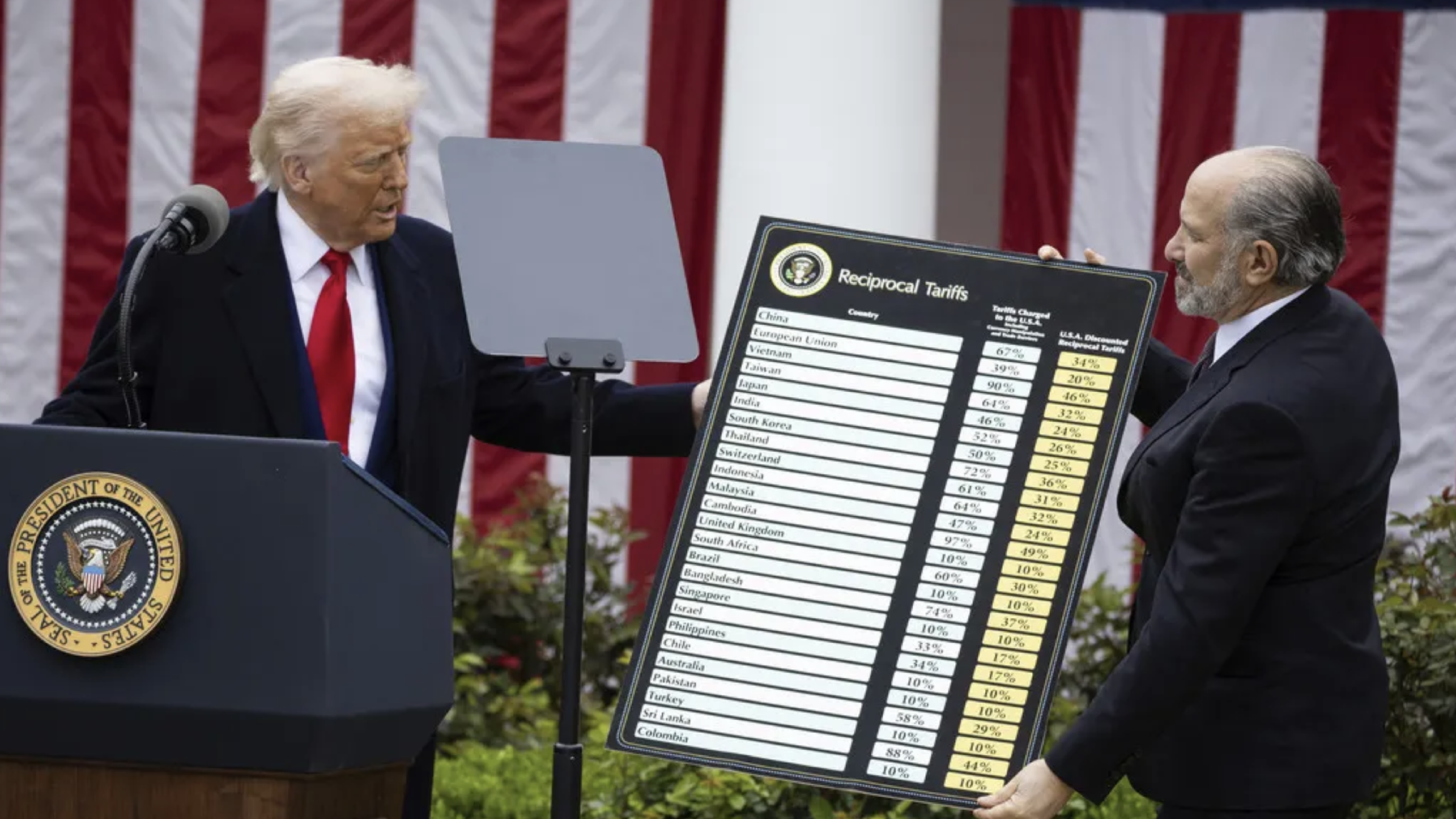
With a few weeks to go to the midterms, the President continues to lose Americans when it comes to his tariff policies. Here’s how some critical races are shaping up.
Republicans will likely lose control of the House of Representatives in the coming weeks. The big question on a lot of minds is whether the Senate will shift to Democratic control as well. Here’s how this match up looks right now.
Republicans hold 53 seats, the Democrats have 45 and there are 2 Independents, who mostly lean Democrat. When there is a tie vote, the Vice President casts a deciding vote, so the Democrats actually need a net gain of 4 to secure control.
Unlike the House of Representatives, not all Senate seats are contested at the same time. This year, 35 seats are being contested: 22 Republican held and 13 Democrats.
To shift control, the Democrats need to hold all their own seats and pick up 4 others. Polling shows a fairly wide “generic ballot” advantage for the Democrats (around 8 points), which means that the Democrat held seats are likely fairly safe. Midterms generally don’t favour the White House incumbent’s party, and Trump is pretty far underwater. Independent voters are unhappy, and Republican voters are less motivated to turn out, compared to Democrats.
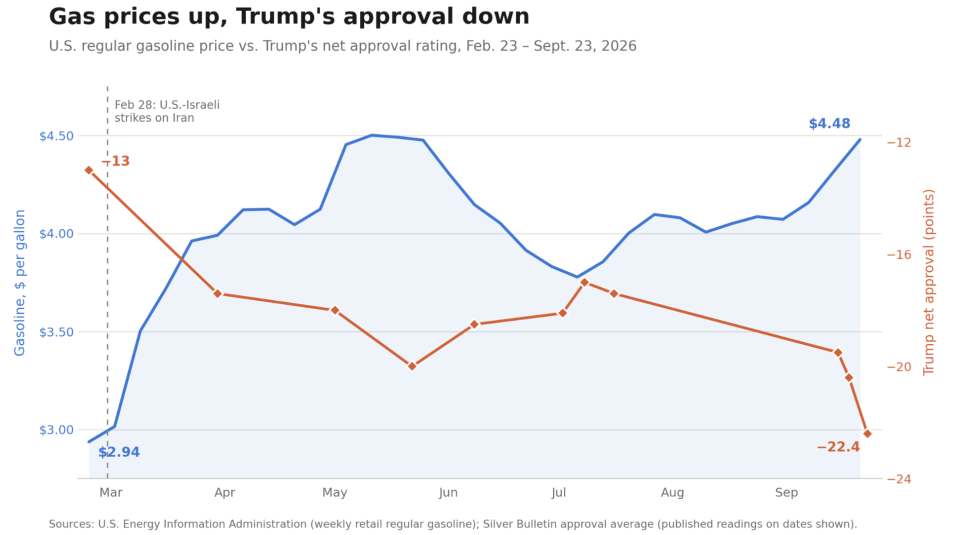
The cost of living, and in particular, the cost of gasoline and diesel are the factors that have shifted a challenging election for the Republicans to something that looks more like a potential wave for the Democrats. The chart below illustrates the strong relationship between gas prices and Trump favourability since the Iran war was launched.
So let’s turn back to the Senate.
Of the 35 seats being contested, there are 10 that may matter the most.
Democrats must retain: Georgia, Michigan and New Hampshire
The Democrats need Jon Ossoff to hold Georgia, Abdul El-Sayed to win in Michigan, and Chris Pappas to win in New Hampshire. Ossoff looks solid, the other two races will confirm whether a blue wave is happening, but both Democrats have shown modest leads in polling.
Democrats need to pick up 4 of: Maine, Texas, North Carolina, Alaska, Ohio, Iowa and Nebraska.
Based on the most recent polling, Maine, North Carolina, Ohio, Texas, and Alaska look like the most plausible pick ups for the Democrats. Iowa is competitive, with Josh Turek holding a slight lead. Nebraska is a race between an incumbent Republican Pete Ricketts versus Dan Osborn, who is running as an Independent. Osborne has been harshly critical of the Republicans, but has said that if he wins, he won’t caucus with either party.
Some observers now believe Kansas is in play, with Republican incumbent Roger Marshall facing a strong challenge from Adam Hamilton. Democrats haven’t won a Senate seat in Kansas in 94 years. Hamilton is well liked, Marshall isn’t, and Kansas has been unhappy about fuel, fertilizer, and Trump’s attack on Bombardier, which manufactures in Wichita.
Finally, there’s more conversation about whether late South Carolina Senator Lindsey Graham’s sister Darline will be able to hold onto that seat for the Republicans. She remains the favourite in a state Trump carried by almost 18 points in 2024, but the fact that it is part of the conversation underscores how much the Republicans are playing defense this fall.
One of the reasons I’m so focused on these mid terms is the potential to create a reset in how America approaches the conversation about tariffs and Canada. To understand the potential, it’s useful to look at the positions some of the most important Democratic candidates have taken.
To fully develop the context for a post mid term reset, it’s useful to look at how the Republican opponents of these candidates are approaching the topic of tariffs. In short, 2 oppose tariffs, 3 are pretty quiet; 5 are mixed/qualified in their support for tariffs and just 1 backs Trump’s approach unequivocally (Mike Collins in Georgia).
In other words, the Republican campaign to hold on to the Senate is mostly trying to avoid harm from the tariff war that Trump started.
In border states like Maine and New Hampshire (e.g. Republican Senate Candidate John Sununu: “This is not China we’re dealing with; it’s Canada - our best friend, a country with whom our economy is completely intertwined”, Republicans are particularly unhappy with Trump’s attacks on Canada.
Since September 1, 159 Senators, Governors and Representatives have posted on X about tariffs. There’ve been a total of 358 posts. 339 of those posts have been against tariffs.
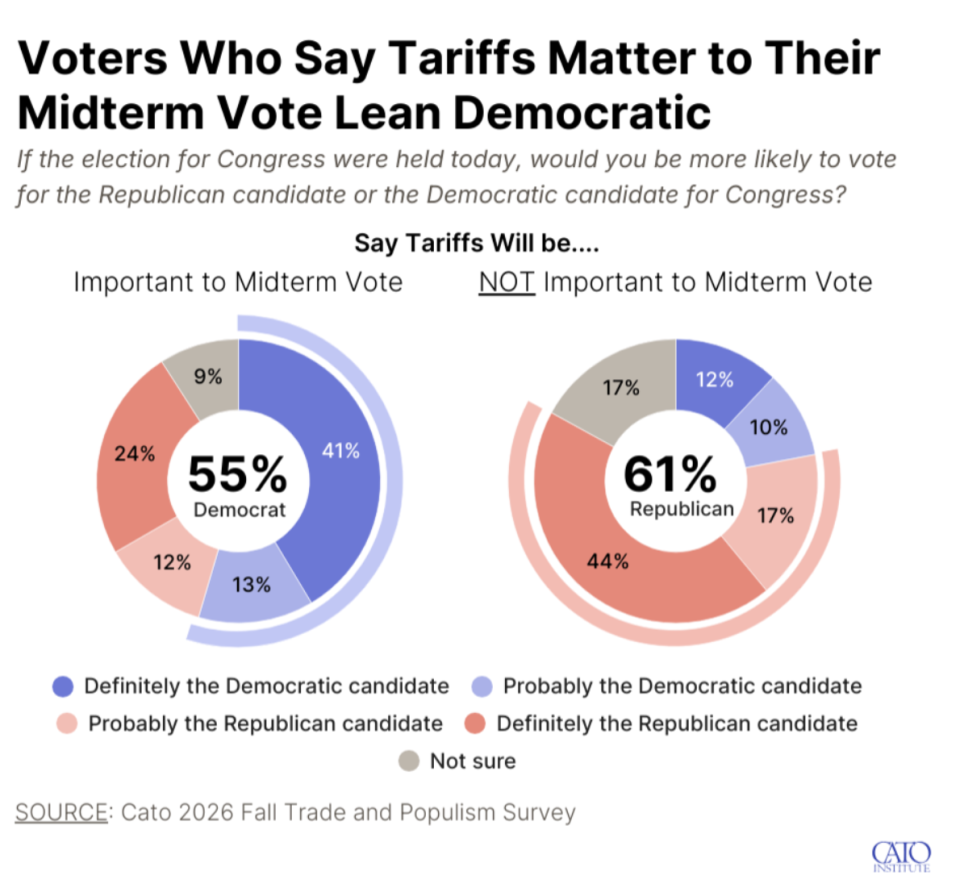
A poll released by the CATO Institute this week shows that 74% of Americans think tariffs have driven up their cost of living, and 75% say tariffs will play a role in how they vote in November. Among the 75% who say tariffs will be important to their vote, the Democrats have an 18 point advantage.
To sum it up, Trump’s tariffs are adding weight, not lift, to the US economy and to Republican election prospects. Democrats are ready to recalibrate if they win more power, but there will be a few different starting points, including:
The relative importance of these will vary by the regional and other sensitivities of the individual politicians, but in the aggregate the patterns suggest there would be room to create a new and better conversation within Congress, if in fact the Democrats enter December with more power than they have today.
spark*insights is led by Bruce Anderson, one of Canada’s leading and most experienced public opinion researchers. From polling and research to analysis and guidance, we help organizations, uncover the factors driving or influencing public perception to gain valuable insights into the shape and movement of the landscape.
Tell us your needs, challenge us with your project, get an estimate, come for a coffee and a chat (or reach out for a virtual one)!
Address: 71 Bank Street, 6th Floor, Ottawa, Ontario, K1P 5N2
Email: hello@sparkadvocacy.ca
Telephone: (613) 367-5513
Follow us on social:


© 2026 spark*advocacy Inc., All rights reserved.