
Subscribe for more!
Subscribe to our newsletter for insights and articles on wide ranging issues including reputation management, branding, advertising, awareness, advocacy, and communications. You can unsubscribe anytime.
Follow us on social:


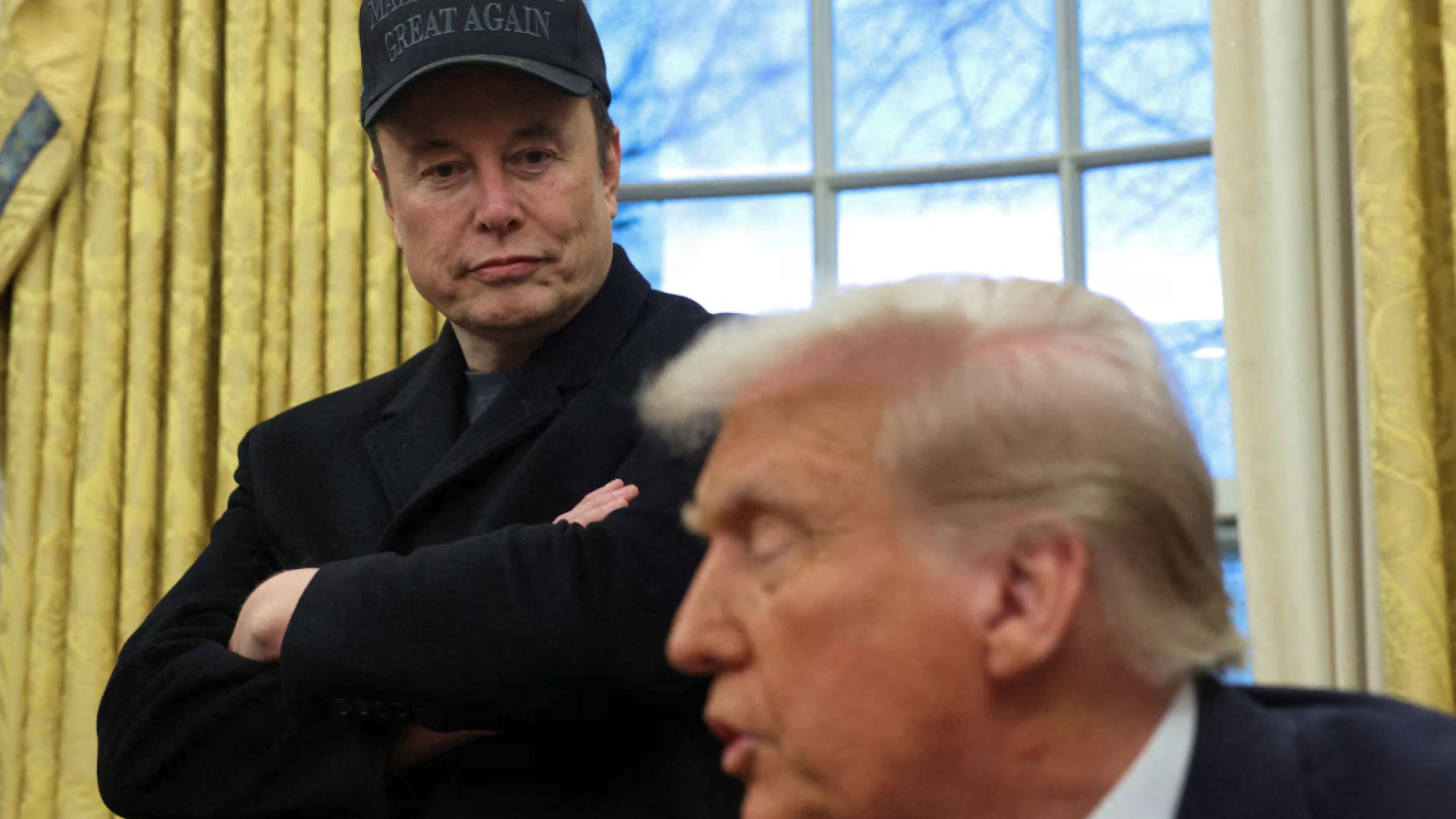
Roughly 1 in 3 Canadian Conservative voters have opinions so far adrift of the Canadian mainstream, they are more like an anchor holding the party down, than a base to build on.
(In a large sample nationwide survey we conducted at the end of October 2026 we interviewed 1100 people who said they voted Conservative in the last federal election, I compared the results among Conservative voters who like Donald Trump (31% or 340 cases), to the views of Conservative voters who don’t (69%). This is meant to better understand the schism that Trump has triggered or exacerbated within Canada’s Conservative Party. )
There were a total of 63 different variables used in this analysis, including demographics, feelings about politicians and major public figures, feelings about federal politics and government, and world views.
Other than their feelings about Trump, what variables revealed the widest differences between a Trump Conservative and a Non Trump Conservative?
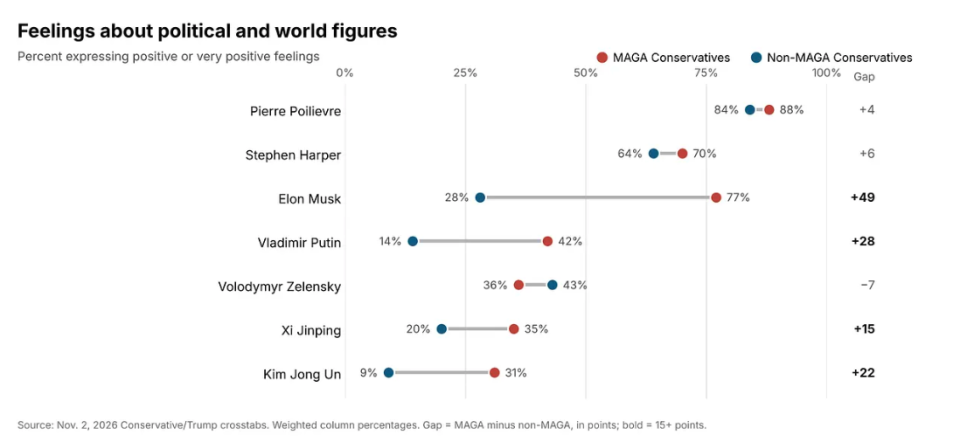
Trump Conservatives like Elon Musk. Most other people, including most other Conservatives, don’t.
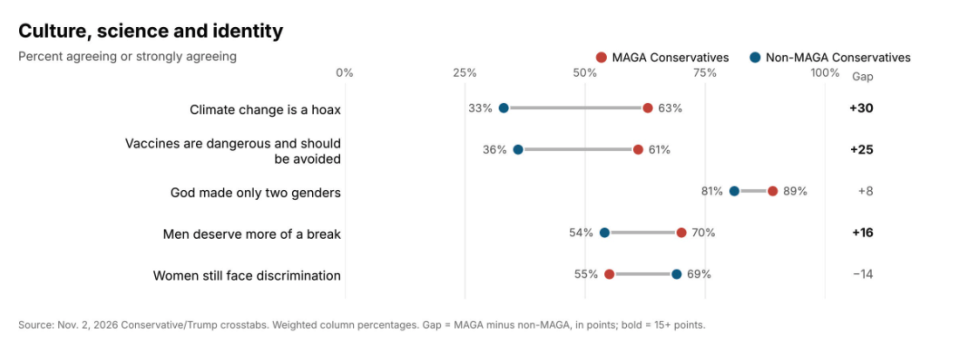
Trump Conservatives are also warmer towards Vladimir Putin, Xi Jinping and Kim Jong Un, some of Donald Trump’s favourite authoritarians. And, like Trump, Canada’s Trump Conservatives are dismissive of climate change and vaccine science. Here are some examples of what the data reveal.
Trump Conservatives are (compared to Conservatives who don’t like Trump):
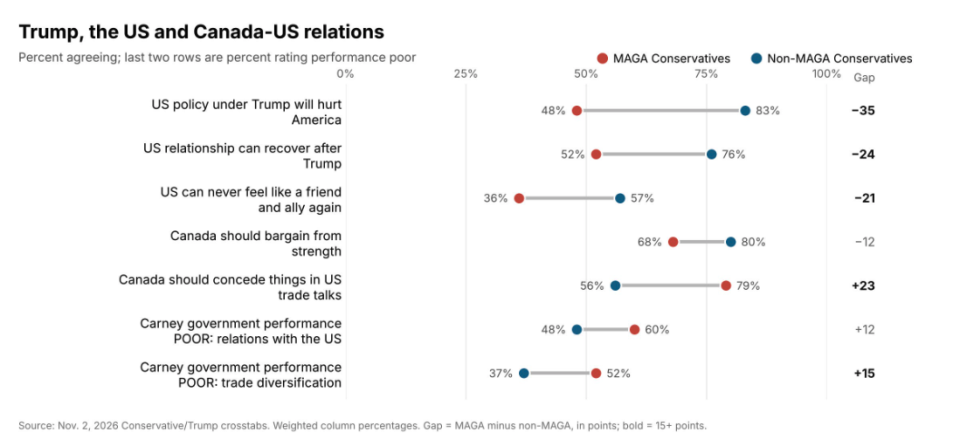
Non Trump Conservatives are (compared to Conservatives who like Trump):
More likely to believe that Trump policies are harming America, that the US-Canada relationship can recover, but that we might never feel like the US is as close a friend and ally.
They are also more likely to believe that vaccines are essential to public health and that climate change is a real problem.
They are more likely to believe Canada is the best country in the world and that we should bargain from a position of strength.
Trump’s effect, has been to weaken the competitiveness of the Canadian Conservative Party, in much the same way as he has eroded the competitiveness of the US Republican Party: by being a champion for a world view that most other people feel either perplexed or repelled by.
Trump’s influence is to create doubt about science and trust in autocrats, and more division. It’s a combination that unlikely to gain a lot more popularity than it already has.
Canada’s Conservatives have long had factions, which represented challenges for leaders like Joe Clark, Brian Mulroney and Jean Charest who preferred to focus on a building a mainstream coalition.
The factions held together pretty well under Stephen Harper, but he exited before the arrival of Trump. Poilievre and Scheer have pulled on MAGA populist energy but found a wall of pragmatic, centrist Canadians who were looking for something less, well less Trumpy.
Erin O’Toole had the right idea, but by then the Conservative Party was a party where leaders followed, rather than led, the rank and file. And the rank and file (don’t forget they almost picked Max Bernier) was pretty Trumpy.
Where to from here?
The federal Conservative Party could conceivably win an election without grappling with and settling this internal schism. But today, the Trump Conservative cohort is about 13% of the electorate - hard to walk away from but more of a poison pill that surfaces for voters every time there’s something like an caucus inquiry on vaccines.
But to let this schism continue to play out publicly, is to accept the odds of success are long, and rest almost entirely on running against an unpopular and much more left-oriented Liberal leader and platform. It’s hard to see that happening in the near term.
There are three strategic paths for the Conservative Party.
The first feels like hope more than strategy.
The second may be the best idea in theory, but only in theory, because Poilievre may not be willing or credible at delivering on that strategy. And, there’s no guarantee that even if he was willing, he’d be able to win as many votes on the centre as he might lose if Trump Conservatives stay home, or look for a new home (recalling Reform and the People’s Party).
The third is highly risky, but still might be the best available choice.
For the moment, anyway, (even as Elon says he’s not MAGA), about a third of Canadian Conservative voters remain enamoured of both Trump and Elon, and out of step with the mood and agenda of most other Canadians, and most other Conservatives.
spark*insights is led by Bruce Anderson, one of Canada’s leading and most experienced public opinion researchers. From polling and research to analysis and guidance, we help organizations, uncover the factors driving or influencing public perception to gain valuable insights into the shape and movement of the landscape.
Tell us your needs, challenge us with your project, get an estimate, come for a coffee and a chat (or reach out for a virtual one)!
Address: 71 Bank Street, 6th Floor, Ottawa, Ontario, K1P 5N2
Email: hello@sparkadvocacy.ca
Telephone: (613) 367-5513
Follow us on social:


© 2026 spark*advocacy Inc., All rights reserved.